
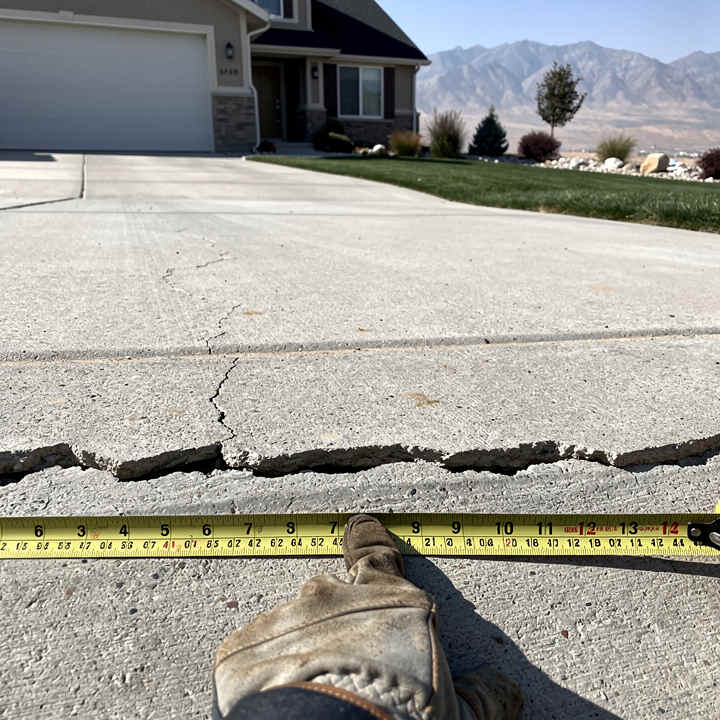
If your driveway, patio, or walkway has cracks wider than a quarter inch, standing water that won’t drain, a flaking surface, sunken sections, or gaps opening up at the joints, it needs repair now — before winter, not after. In Eagle Mountain, water that sits in concrete damage freezes, expands, and turns a small problem into a much bigger one by spring. Below are the five warning signs Xpert Concrete & Seal sees most often on Eagle Mountain driveways and patios this time of year, and what each one means for your timeline.
Eagle Mountain has grown fast — from just over 32,000 residents in 2017 to more than 60,000 today — and a huge share of that growth is concrete poured within the last five to fifteen years across neighborhoods like Silverlake, Overland, and the Pony Express corridor. That first decade is exactly when hairline cracks and minor surface issues start showing up, right as winter freeze-thaw cycles start testing them. At Eagle Mountain’s elevation near 4,900 feet, winter lows regularly drop into the teens and the area sees around 46 inches of snow a year — more than double the national average. Every freeze-thaw cycle pushes water in cracks harder, which is why timing repairs before the cold sets in matters more here than in lower-elevation parts of the valley.
1. Cracks Wider Than a Quarter Inch
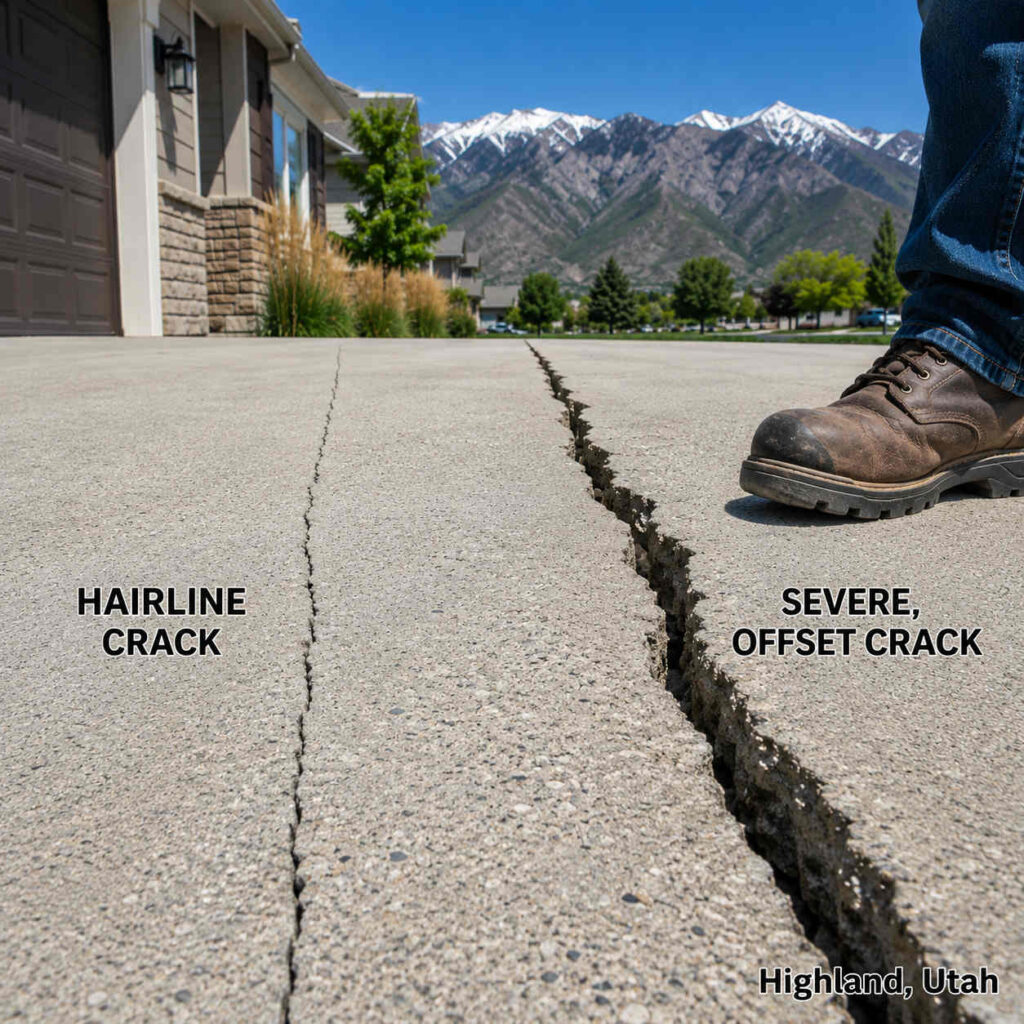
Hairline cracks under 1/8 inch are cosmetic and can usually wait. Once a crack opens past 1/4 inch, or you can see daylight or feel a lip between the two edges, water is getting below the surface every time it rains or the sprinklers run. In Eagle Mountain, that water doesn’t just sit there — it freezes. Water expands about 9% in volume when it turns to ice, and inside a crack that expansion pries the concrete apart from the inside. A crack that’s stable in October can be double its width by March if it goes into winter unsealed.
What to check: run a fingernail along the crack. If it catches on a lip or ledge where one side has settled lower than the other, that’s no longer a surface crack — it’s a sign the base below the slab has already moved.
2. Standing Water or Pooling After Rain or Irrigation
Concrete is supposed to shed water toward the yard or the street, not hold it. If you’re seeing puddles that take more than a few hours to drain — especially in the same spot every time — the slab has lost its original pitch. That’s usually from the base settling unevenly underneath, which is common in newer subdivisions where fill soil is still compacting years after the pour.
Pooling water is the most urgent sign on this list heading into an Eagle Mountain winter. Standing water freezes first and stays frozen longest, since ice sitting directly on the slab surface has nowhere to drain even as temperatures cycle above freezing during the day. A section that pools water in October will very likely be a sheet of ice by January — a slip hazard right at your front door or garage.
3. Flaking, Peeling, or Spalling Surface
Spalling is when the top layer of the concrete — usually just the top 1/4 to 1/2 inch — starts to flake, pit, or peel away, often leaving small chunks or a rough, pitted texture where the surface used to be smooth. It’s frequently caused by de-icing salt, over-finishing during the original pour, or repeated freeze-thaw cycling from a previous winter that already weakened the surface bond.
Once spalling starts, it accelerates. A rough, pitted surface holds more moisture than a smooth one, which means more freeze-thaw damage the following winter. Sealing or resurfacing before the cold hits can stop a spalled section from spreading across the whole slab — but that window closes once temperatures are consistently below the 40s, since most sealants and patch materials need warmer weather to cure properly.
4. Sunken or Uneven Slab Sections
If part of a driveway, patio, or walkway has dropped relative to the section next to it — even by half an inch — the soil or gravel base underneath has shifted, washed out, or settled. This is common in Eagle Mountain’s newer construction, where clay-heavy native soil and imported fill can settle unevenly for years after a home is built, especially near downspouts, sprinkler lines, or areas where grading directs water toward the foundation.
An uneven slab isn’t just a tripping hazard — it changes how water moves across the surface, often creating a new low point that starts pooling (see #2 above). Left alone through a winter, freeze-thaw cycling in the gap beneath the sunken section tends to make the settling worse, not better. Slabjacking or mudjacking can often lift a sunken section back into place for meaningfully less than a full replacement, but it works best when the ground isn’t already frozen solid.
5. Gaps or Separation at Control Joints and Edges
Control joints — the straight lines cut into a driveway or patio — and the outer edges where concrete meets a garage slab, sidewalk, or foundation are supposed to have flexible sealant in them. That sealant is what keeps water, dirt, and de-icing salt from getting into the joint itself. Once that sealant cracks, shrinks, or pulls away — which happens naturally after 5-10 years of Utah sun and temperature swings — the joint is unprotected.
Unsealed joints are one of the fastest and most cost-effective problems on this list to fix, and one of the most expensive to ignore. Water that gets into an unsealed joint and freezes pushes the two slab sections apart, widening the joint every winter until it becomes a full-blown crack. Resealing joints before the first hard freeze is often a same-day fix that heads off years of joint damage.
Which Sign Means Repair vs. Which Means Replace?
Not every sign on this list means the whole slab needs to come out. Here’s a quick reference for what each one typically calls for:
| Warning Sign | What’s Actually Happening | Repair Window |
| Cracks over 1/4″ | Water is already getting below the surface | Now, before first hard freeze |
| Standing water / pooling | Slab has lost its slope or pitch | Now — ice forms fastest here |
| Flaking or spalling surface | Surface layer is already de-bonding | Within 2-4 weeks |
| Sunken or uneven sections | Base material has shifted or washed out | Before winter — settling worsens with freeze/thaw |
| Gaps at joints or edges | Sealant has failed, joint is unprotected | Now — resealing is a quick, straightforward repair |
If more than one of these signs is showing up on the same section of concrete, that’s usually the strongest indicator the base underneath has a problem, not just the surface — worth a look before winter rather than after.
Get Ahead of Winter — Call Xpert Concrete & Seal
If your Eagle Mountain concrete is showing any of these five signs, don’t wait for spring to find out how much worse it got.
Call Xpert Concrete & Seal today at 801-395-4281 — we serve Eagle Mountain and the surrounding Cedar Valley and can assess your driveway, patio, or walkway and tell you exactly what repair option makes sense before the first hard freeze.
Frequently Asked Questions
How much does concrete repair cost in Eagle Mountain?
Cost depends heavily on which of the five signs above you’re dealing with. Resealing joints or filling a single crack is on the lower end of the range; slabjacking a sunken section or resurfacing a spalled area costs more, and full slab replacement is the highest. Xpert Concrete & Seal can give you an exact number after a quick on-site look — pricing varies enough by scope that a phone estimate alone isn’t reliable.
Can concrete be repaired in cold weather?
Most patch materials, sealants, and resurfacing products need surface and air temperatures consistently above 40°F to cure correctly. Once Eagle Mountain hits its typical winter lows in the teens and twenties, many repair options are off the table until spring — which is exactly why catching these signs now, in fall, matters more than waiting.
Will a small crack really get worse over one winter?
Yes, if water is getting into it. Each freeze-thaw cycle expands the ice inside the crack and widens it slightly. Eagle Mountain typically sees dozens of freeze-thaw cycles between November and March, so a 1/4-inch crack left unsealed in October can grow noticeably by the time spring arrives.
Is it too late to seal my driveway before winter?
As long as daytime temperatures are still reaching the 40s and 50s, there’s usually still time. Once nighttime lows drop consistently below freezing, sealant won’t cure properly. The sooner you get an assessment, the more repair options are still on the table.
Do I need to replace my whole driveway if one section is sunken?
Not usually. Slabjacking (also called mudjacking) can lift a sunken section back to level by pumping material underneath it, which is typically far less than a full replacement — as long as the concrete itself isn’t cracked or crumbling beyond the settling issue.
What causes concrete to crack in newer Eagle Mountain neighborhoods?
A lot of Eagle Mountain’s newer subdivisions sit on fill soil and clay-heavy native ground that keeps settling for years after a home is finished. That ongoing settling, combined with Eagle Mountain’s freeze-thaw winters, is why driveways and patios poured within the last decade are often the ones showing these five signs first.