
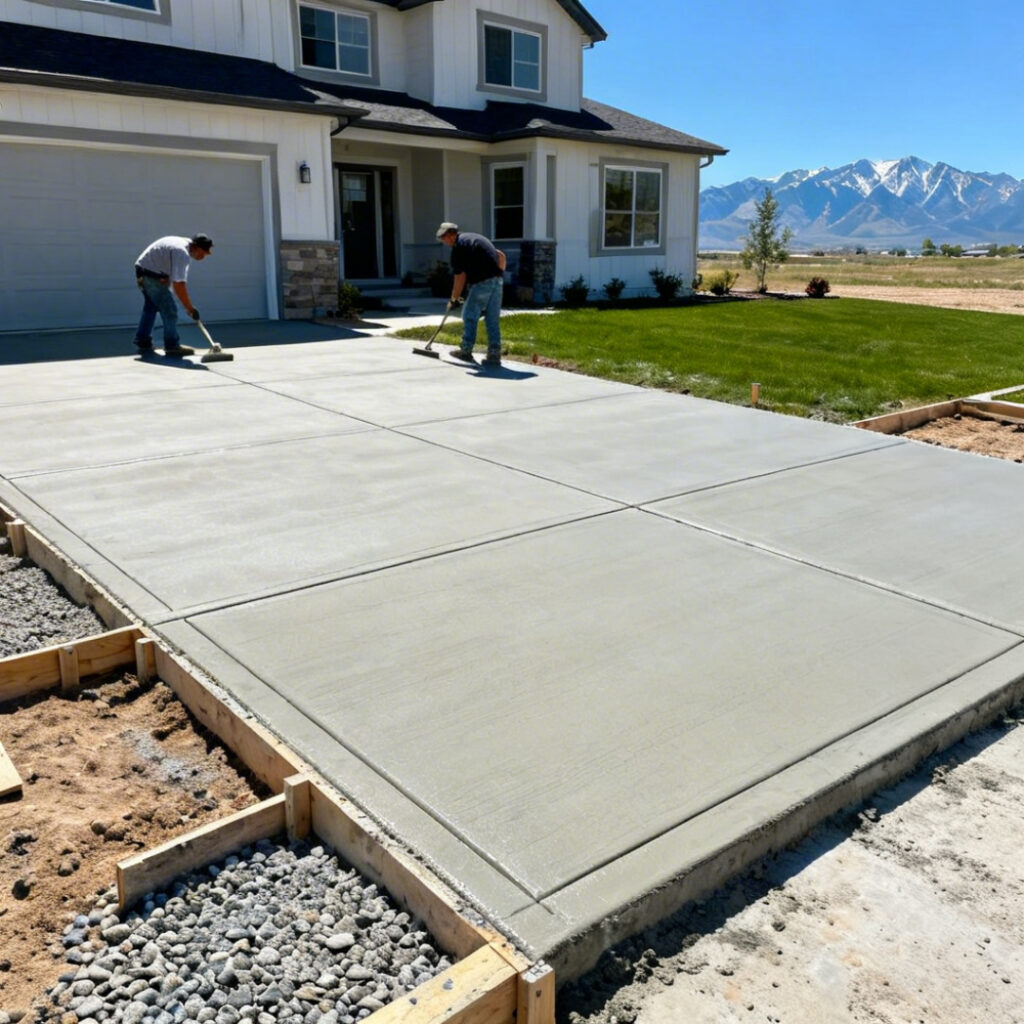
Concrete slabs are the quiet workhorses of your South Jordan property. Driveways, garage floors, walkways, outbuilding foundations, RV pads, pool decks — virtually every horizontal concrete surface on your property rests on a slab. When they perform well, you never think about them. When they crack, settle, spall, or fail, they become impossible to ignore. This guide covers the full spectrum of concrete slab services available to South Jordan homeowners — from new installation to repair to knowing when it’s time for full replacement.
Types of Concrete Slab Projects in South Jordan
South Jordan homeowners request concrete slab services across a wide range of applications. Understanding what each involves helps set expectations for process, cost, and timeline.
Driveway Slabs:
The most visible and heavily used concrete slab on most properties. South Jordan driveways are typically 4 inches thick for standard passenger vehicles and 6 inches for homes with trucks, RVs, or boats. Proper base preparation and 4,000 PSI air-entrained concrete are non-negotiable for durability in Utah’s freeze-thaw climate.
Garage Floor Slabs:
Interior slabs protected from direct weather but exposed to road salt tracked in from South Jordan’s winter roads, vehicle fluids, and heavy loads. A garage slab should be a minimum 4 inches thick (6 inches if heavy vehicles are stored), include a vapor barrier beneath it, and slope toward the door for drainage.
Outbuilding and Shop Foundations:
Detached garages, workshops, and storage buildings in South Jordan’s newer developments frequently require new slab foundations. These require proper sizing for the structure above, adequate reinforcement, and anchor bolt placement coordinated with the framing plan.
RV and Boat Pads:
South Jordan’s family-oriented communities have high rates of RV and recreational vehicle ownership. A dedicated RV or boat parking pad — typically 12 to 14 feet wide and 40 to 50 feet long — requires 6-inch minimum concrete thickness and robust reinforcement to handle the load without cracking.
Pool Decks:
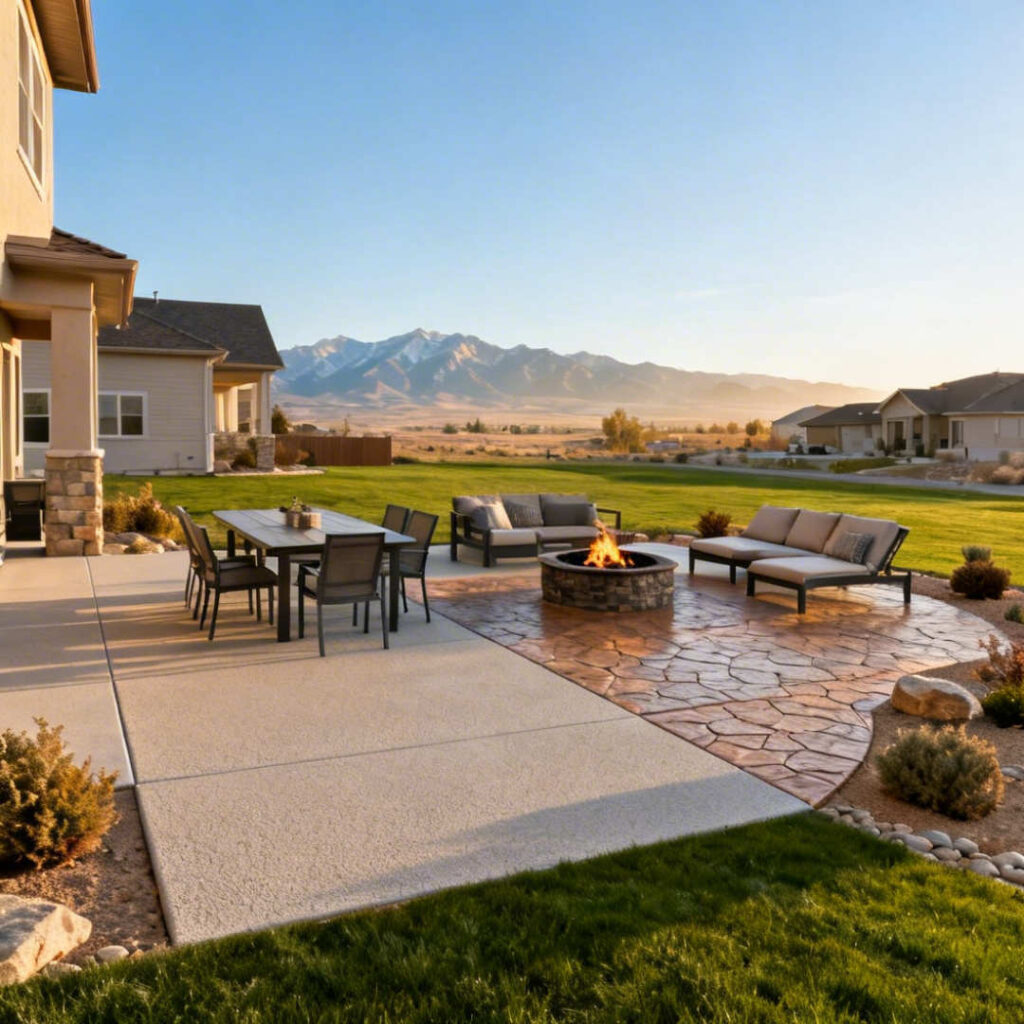
Concrete pool decks require specialized consideration in South Jordan’s climate: non-slip texture, expansion joints that accommodate movement around the pool shell, and finishes that stay cool underfoot in summer heat. Stamped or exposed aggregate finishes are popular choices that balance aesthetics with function.
Walkways and Sidewalks:
Connecting homes, garages, and outdoor areas across South Jordan properties, residential walkways are typically 4 feet wide and 4 inches thick, with control joints every 4 to 5 feet and proper slope for drainage.
New Concrete Slab Installation: The Process in South Jordan
Every quality concrete slab installation in South Jordan follows the same fundamental sequence — shortcuts at any stage lead to premature failure.
Site Preparation and Excavation:
The area is excavated to accommodate both the slab thickness and the required base material. In South Jordan, soil conditions vary — newer developments in the western portion of the city often have sandy loam fill over natural soil, while established neighborhoods closer to the Bangerter Highway corridor may have more clay-heavy native soil. Clay soils require more thorough compaction and drainage planning. A good contractor assesses soil conditions during excavation and adjusts accordingly.
Base Course Installation:
A minimum 4-inch layer of compacted road base or crushed gravel is placed and compacted in the excavated area. This base serves two critical functions: it provides a stable platform that won’t shift under load, and it promotes drainage away from the bottom of the slab — reducing moisture-related deterioration and freeze-thaw damage.
Vapor Barrier:
A 6-mil polyethylene vapor barrier is placed over the compacted base before reinforcement and concrete for garage floors and covered slabs. This prevents ground moisture from wicking up through the slab, which causes surface issues ranging from efflorescence (white mineral deposits) to coating failures in garage floors.
Form Setting:
Lumber forms define the perimeter and finished elevation of the slab. Forms are set to the correct elevation and slope and staked securely. In South Jordan, any slab adjacent to a structure must slope away from the foundation — typically 1/8 inch per foot minimum — to direct water away from the building.
Reinforcement Placement:
Wire mesh or rebar (or both, for heavy-duty applications) is placed on supports (chairs) that keep it in the center third of the slab thickness. Reinforcement is the critical component that prevents cracks from widening and maintains slab integrity through the movement South Jordan’s clay soils and thermal cycles produce.
Concrete Placement and Finishing:
Ready-mix concrete — specified at 4,000 PSI with air entrainment for all exterior South Jordan applications — is placed, screeded, floated, and finished. The finish type (broom, trowel, exposed aggregate, stamp) is applied during the finishing window. Control joints are placed to guide cracking.
Curing:
South Jordan’s dry valley air can pull moisture from fresh concrete before the hydration reaction is complete, producing a weak surface. Proper curing — liquid curing compound or wet burlap with plastic sheeting for 7 days minimum — is what gives the slab its designed strength.
Common Concrete Slab Problems in South Jordan
South Jordan’s specific climate and soil conditions create predictable patterns of slab deterioration. Recognizing these helps homeowners address issues proactively before they become expensive.
Cracking from Settlement:
Portions of South Jordan, particularly in areas with fill soil from ongoing development, experience differential settlement as soils consolidate over time. When soil settles unevenly, slabs lose support, bridge the gap, and eventually crack under bending stress. Settlement cracks are often identifiable by vertical displacement — one side of the crack sits higher than the other.
Surface Spalling:
Freeze-thaw cycling and road salt — both constants in a South Jordan winter — cause the surface layer of concrete to flake and pit over time. Spalling is dramatically accelerated on unsealed concrete and on slabs installed without air entrainment. Mild to moderate spalling can be repaired with a concrete resurfacer if the underlying slab is structurally sound.
Shrinkage Cracking:
Fine hairline cracks within the first few weeks or months after installation are common and primarily cosmetic. They result from normal concrete shrinkage during curing. While not structurally significant, they should be sealed to prevent water infiltration that leads to freeze-thaw widening over time.
Heaving from Tree Roots:
South Jordan’s established neighborhoods have mature trees whose root systems eventually find their way beneath sidewalks, driveways, and patio slabs. Root decay creates voids; root growth creates upward pressure. Both scenarios disrupt slabs over time.
Slab Repair Options for South Jordan Homeowners
Crack Filling and Sealing:
For hairline to moderate cracks (up to 1/2 inch wide) in structurally sound slabs, polyurethane or epoxy crack filler effectively seals the crack against moisture. Proper preparation — cleaning the crack, removing loose material, and using backer rod for deep cracks — determines whether the repair holds. Always seal the repaired area afterward.
Mudjacking / Polyurethane Foam Lifting:
For settled sections of otherwise sound slabs, lifting is often the most cost-effective approach. Holes are drilled through the slab, slurry or expanding foam is injected beneath, and the slab is raised to original grade. Several South Jordan-area contractors specialize in slab lifting with both traditional mudjacking and the newer polyurethane foam method.
Concrete Resurfacing:
For slabs with surface deterioration — spalling, scaling, or aggregate exposure — a cement-based resurfacer creates a fresh 1/8 to 1/4 inch surface layer. Done properly with appropriate surface preparation and bonding agent, a resurfaced slab looks like new and provides another decade or more of service life.
Section Replacement:
When one section of a driveway or slab system has failed while others remain sound, replacing the specific failed section is often the right balance of cost and longevity. The challenge is matching color and texture to the existing slab — new concrete is lighter than aged concrete, so an exact match immediately after pour isn’t achievable. Color harmonizes over time.
When Full Slab Replacement Is the Right Decision
Full slab replacement makes sense in South Jordan when cracking is widespread and structural, spalling covers more than 25 to 30 percent of the surface, multiple sections have settled significantly and lifting has already failed, the slab is at or near the end of its expected service life (30+ years old and showing it), or the cumulative cost of repairs would exceed 40 percent of replacement cost. When replacement is the decision, it’s also the opportunity to fix what caused the original failure — improve drainage, specify better concrete, add reinforcement where it was absent, and correct any grade issues.
South Jordan Concrete Slab Costs in 2025
Current South Jordan area pricing for concrete slab services:
- New slab installation: $6 to $12 per sq ft (standard); $14 to $22 per sq ft (decorative)
- Crack repair: $5 to $15 per linear foot
- Mudjacking / foam lifting: $3 to $8 per sq ft of lifted slab
- Resurfacing: $3 to $8 per sq ft
- Full replacement (incl. demo & disposal): $8 to $15 per sq ft
Get written, itemized bids from at least three licensed Utah contractors for any project over $2,000.
Contact a South Jordan Concrete Slab Specialist
Whether you’re installing a new slab for an outbuilding, repairing a cracked driveway, or replacing a deteriorated garage floor, South Jordan homeowners deserve concrete services that are done right the first time. The combination of proper mix specification, thorough base preparation, and skilled installation determines whether your slab serves you for decades or becomes a problem in a few years. Partner with a licensed, experienced concrete contractor who knows South Jordan’s soils and climate — and enjoy concrete that performs as well as it looks.