
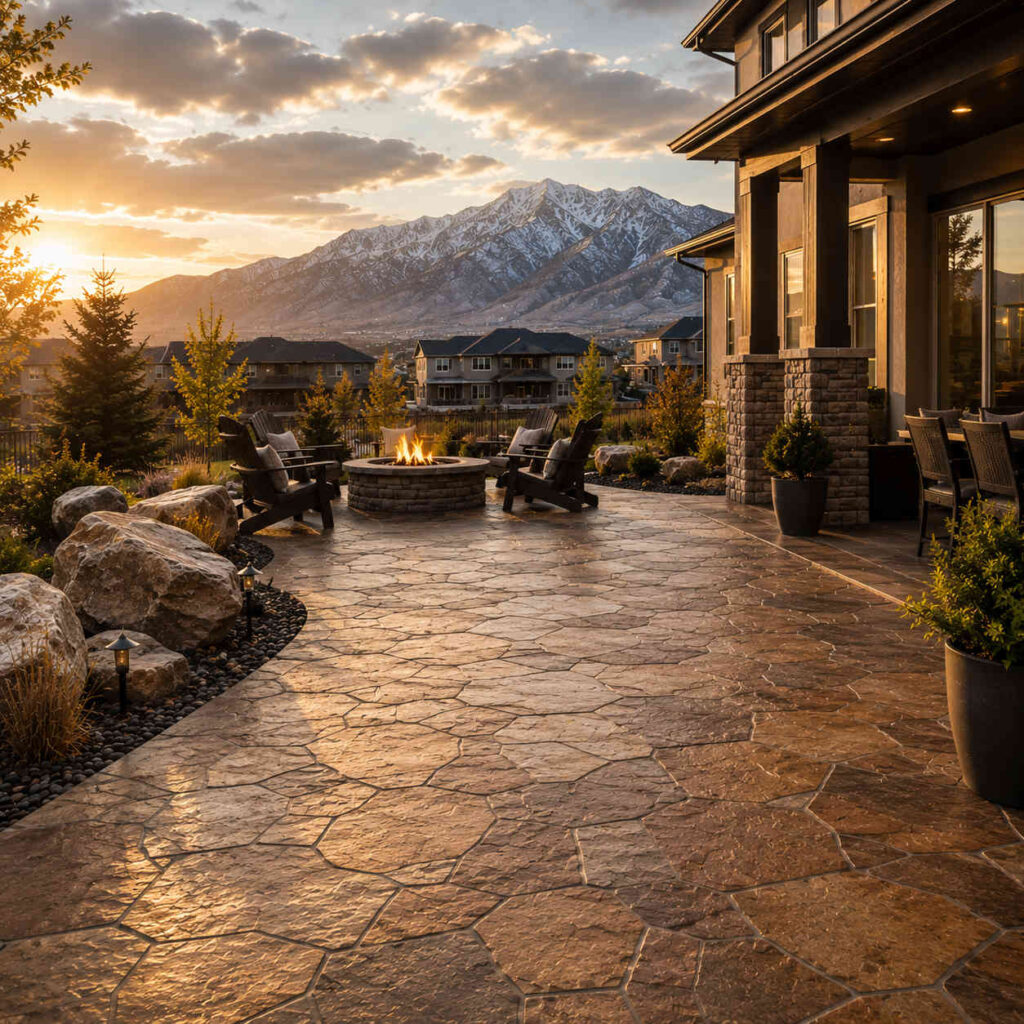
Eagle Mountain has more bare dirt backyards per capita than just about any city in Utah. That’s not a criticism — it’s a natural byproduct of the city’s growth pattern. Thousands of families have moved into new builds along Pony Express Parkway and throughout Cedar Valley in the last decade, moved in immediately, and then looked at the untouched patch of desert behind their house and started saving for something better. Stamped concrete is where a lot of those plans land — and for good reason. You get the visual character of natural stone or brick, the long-term durability of concrete, and a price point that’s significantly lower than laying actual flagstone or installing premium pavers. But there are real choices to make and real risks to understand before you pour a single yard of concrete in Cedar Valley’s climate. Here’s what you need to know.
What Stamped Concrete Actually Is — and How It Gets That Look
Stamped concrete starts as standard concrete — the same mix poured for a basic gray slab. What makes it decorative is what happens in the 30 to 90-minute window after placement, while the concrete is still workable but firm enough to hold an impression. Rubber stamp mats are pressed into the surface in a repeating pattern, creating texture that mimics stone, brick, slate, or wood. Color comes from two sources: integral color mixed into the concrete itself for base tone, and a release agent powder dusted on the surface before stamping that highlights the high points of the pattern and creates the depth variation that makes the finished surface look like real material rather than painted concrete.
The result, when done by an experienced crew, is genuinely difficult to distinguish from natural stone at normal viewing distance. Cobblestone, flagstone, Ashlar slate, herringbone brick, wood plank — each pattern creates a completely different character. For Eagle Mountain homes with the mountain desert aesthetic common in Cedar Valley, flagstone and cobblestone patterns in earth tone colors — sandstone, terra cotta, warm browns — work exceptionally well with both the natural landscape and the exterior palettes common in the newer neighborhoods.
Why Eagle Mountain’s Climate Demands More from Stamped Concrete
This is the part that separates a stamped concrete patio that lasts 25 years from one that starts scaling and fading in 4. Eagle Mountain sits at roughly 4,900 feet elevation — noticeably higher than the Salt Lake Valley — and Cedar Valley’s exposure means colder winters, more wind, and freeze-thaw cycles that are harder and more frequent than what you’d experience in South Jordan or Sandy. Freeze-thaw damage is the primary way stamped concrete fails prematurely in this part of Utah County.
The mechanism is straightforward: moisture enters the concrete surface through micro-pores, freezes, expands by about 9 percent, and breaks apart the near-surface matrix. Repeat that 40 or 50 times in a winter — which is realistic in Cedar Valley — and an unprotected stamped surface begins to scale and lose the crisp detail that made it worth paying for. The protection against this has two components. First, the concrete mix itself: 4,000 PSI minimum with 5 to 7 percent air entrainment. Air-entrained concrete contains microscopic bubbles distributed throughout the paste that give freezing water room to expand without building destructive pressure. Second, the sealer: a UV-resistant acrylic or polyurethane topcoat applied after full cure that closes the surface against moisture infiltration. In Eagle Mountain’s high-elevation UV environment, a sealer without UV stabilizers will chalk and degrade within two seasons.
Both components have to be right. Air entrainment without sealing leaves the surface exposed. Sealing over a non-air-entrained slab gives you a nice-looking surface for two or three years before the freeze-thaw damage that was building underneath breaks through. Ask any contractor quoting your stamped concrete project what PSI they’re specifying and whether the mix is air-entrained. A contractor who can’t answer that question specifically isn’t the contractor for a stamped concrete job in Cedar Valley.
Pattern and Color: Choosing What Works for Eagle Mountain Homes
Pattern and color choices for stamped concrete are wider than most homeowners expect when they first start researching. Xpert Concrete & Seal offers cobblestone, flagstone, slate, brick, and wood plank textures in dozens of color combinations. For Eagle Mountain homes, a few combinations consistently produce the best outcomes.
Flagstone in sandstone or adobe tones: The most popular choice in Cedar Valley, and for good reason. The irregular stone pattern reads as natural in a way that manufactured materials don’t, and the warm earth tones complement both the Oquirrh Mountain backdrop and the stucco, stone, and warm-palette home exteriors common throughout Eagle Mountain’s newer neighborhoods.
Cobblestone in charcoal or slate gray: Works especially well for driveways and front entries where a more formal, European character is appropriate. Holds up well visually as it ages because the pattern depth makes minor fading less noticeable than it would be on a flat-textured surface.
Ashlar slate in buff or golden hue: The rectangular stone-block pattern that works with contemporary and transitional architecture. If your home has clean lines and a modern palette, Ashlar slate in lighter tones creates a sophisticated look without competing with the architecture.
Wood plank: A niche option that’s genuinely striking in the right setting — particularly on covered patios and outdoor living areas where the wood aesthetic makes sense. The grain lines and color variation of a quality wood plank stamp create a surface that reads as warm and residential rather than hard and utilitarian.
One practical note on color: new stamped concrete is always lighter and brighter than it will look after the first full season. The integral color cures and the sealer develops its final sheen over 28 to 60 days. If your contractor shows you a color chart, ask to see photos of completed jobs at 6 months and 2 years, not just immediately after installation.
What Stamped Concrete Costs in Eagle Mountain, UT
In the Eagle Mountain and broader Utah County market, stamped concrete patios run $12 to $20 per square foot installed for standard single-pattern, single-color work. Multi-pattern designs or premium color combinations push pricing toward $18 to $25 per square foot. Compare that to standard gray brushed concrete at $7 to $12 per square foot and you’re paying a $5 to $10 per square foot premium for the decorative work. On a 400 square foot patio, that’s a $2,000 to $4,000 difference — significant, but not the $8,000 to $12,000 premium you’d pay for comparable natural flagstone installed by a landscape contractor.
What drives price beyond basic pattern and color: site access (concrete trucks can’t always reach a backyard in Eagle Mountain’s denser neighborhoods), demolition of existing concrete, base preparation complexity, and project size. Larger projects benefit from per-square-foot price reductions. A 600 square foot patio will generally come in cheaper per foot than a 200 square foot one because the setup and mobilization costs spread across more area.
Sealing: The Maintenance Step Eagle Mountain Homeowners Can’t Skip
A stamped concrete patio in Eagle Mountain needs resealing every 2 to 3 years under normal conditions. That schedule shortens to every 18 to 24 months on south-facing surfaces with full sun exposure or in the higher-elevation, higher-UV conditions of Cedar Valley’s exposed lots. The test is simple: pour a small amount of water on the surface. If it beads and rolls off, the sealer is working. If it absorbs within a few seconds, it’s time to reseal.
Resealing is a DIY-accessible task on a properly prepared surface — clean the patio with a pressure washer and concrete cleaner, allow 24 to 48 hours to dry, and apply a fresh coat with a roller or pump sprayer. The material cost runs $80 to $200 for an average residential patio. Skipping resealing doesn’t just affect appearance — it exposes the surface to the freeze-thaw damage that is the most common cause of premature stamped concrete failure in Eagle Mountain’s climate.
Frequently Asked Questions
How long does stamped concrete last in Eagle Mountain, UT?
25 years or more with proper installation and regular sealing. The key variables in Eagle Mountain specifically are air-entrained concrete mix and a UV-resistant sealer that gets renewed every 2 to 3 years. Skip either and the lifespan shortens considerably.
Can stamped concrete crack in Utah’s winters?
All concrete can crack. Control joints placed during installation direct cracking to straight, intentional lines rather than random fractures across the surface. Properly placed control joints and a properly specified mix dramatically reduce cracking. Minor cracks that do develop can be filled with color-matched caulk with good results when addressed early.
Does stamped concrete get slippery in winter?
The texture from stamping provides more traction than a smooth trowel finish. For additional slip resistance in icy conditions, a non-skid additive can be mixed into the topcoat sealer. If your patio or walkway is in a north-facing area that holds ice, mention this to your contractor during the design process.
Can I add stamped concrete over my existing slab?
Yes, with a stamped overlay — a thin polymer-modified concrete layer applied over existing concrete that can be stamped and colored. The existing slab needs to be structurally sound and properly prepared. It’s a legitimate option for upgrading old concrete without full demo and replacement.
How soon can I use my stamped concrete patio after installation?
Light foot traffic after 24 to 48 hours. Patio furniture and normal use after 7 days. Full curing and final sealer application at 28 days. Avoid heavy equipment or vehicles on new stamped concrete for at least 28 days.
What questions should I ask a stamped concrete contractor in Eagle Mountain?
Ask what PSI concrete they’re specifying, whether it’s air-entrained, how they handle the release agent application for color consistency, what sealer product they use and whether it’s UV-rated, and whether they can show you photos of completed work at 1 to 2 years post-installation in Eagle Mountain or similar Utah County conditions.
Xpert Concrete & Seal serves Eagle Mountain with stamped and decorative concrete built for Cedar Valley’s climate — air-entrained mix, proper base prep, and UV-rated sealing included. Call (385) 560-9123 for a free on-site estimate. Serving Eagle Mountain, Saratoga Springs, Lehi, and all of northern Utah County.