
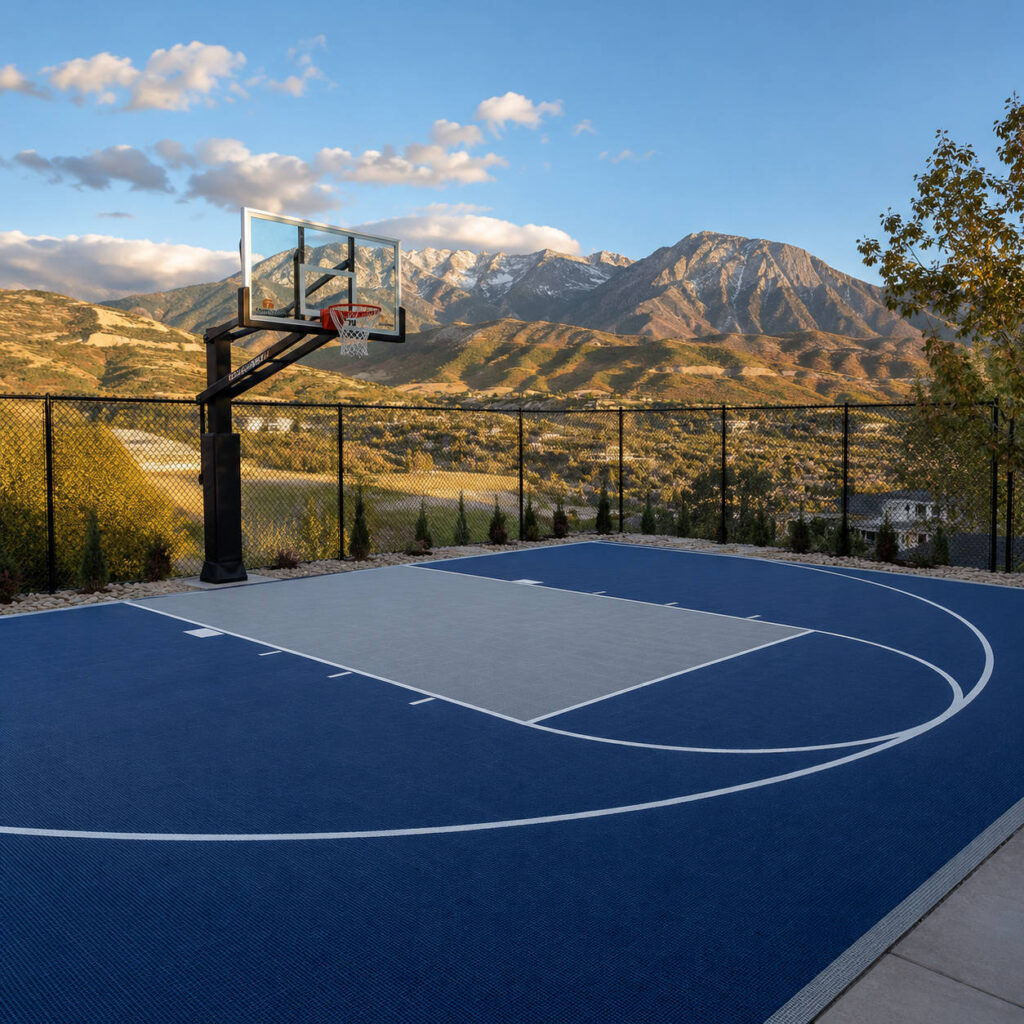
Backyard Basketball Courts in Draper, UT: Built for Serious Players
Draper is a city that takes athletics seriously. Corner Canyon High School’s programs have produced athletes who compete at every level, and the culture that makes that possible starts in backyards and driveways long before a player puts on a varsity jersey. For Draper families with kids grinding through city leagues, training through club programs, or simply playing every afternoon with the neighbors, the idea of a home court isn’t a luxury — it’s a logical investment in the activity they’re already paying for in court time fees and driving hours. And with the large lots in Suncrest, South Mountain, Highland Estates, and the Corner Canyon corridor, more Draper properties can accommodate a quality court than most homeowners realize.
This guide covers what a backyard basketball court installation looks like in Draper specifically — the sizing decisions, the concrete specifications that matter at the Wasatch Front’s southern edge, the surface finish and coating options, the add-ons worth considering, and the questions that help you evaluate whether a contractor is quoting quality work or a short-lived slab.
Draper’s Lots: What You Can Actually Fit
Draper’s residential lot sizes vary considerably by neighborhood. The larger custom home lots in Suncrest, Highland Estates, and the upper portions of the South Mountain development often have enough flat usable space for a full half court — 30 by 50 feet — with room to spare for landscaping, a patio, or other outdoor amenities. Tighter lots in Draper’s older or more densely developed neighborhoods may limit the footprint to a practice-and-shooting court in the 28-by-35-foot range.
Before any design conversation happens, measure what you actually have. Note the flat usable area after accounting for property line setbacks (check with Draper City’s zoning department or your HOA if applicable), existing structures, established landscaping, and any grade changes across the proposed court area. A court built on a site that requires significant grading will cost more than one on a naturally flat area — the excavation and base work is a bigger lift. Grade changes of more than a foot across the court footprint are worth flagging with the contractor early in the planning process.
For reference: a 28-by-40-foot shooting court accommodates a key, a free throw line, and a three-point arc on one end — plenty of space for individual skill work and two-on-two. A 30-by-50-foot half court has the proportions for real three-on-three and four-on-four runs and is the size most Draper families land on when they have the space. A 50-by-84-foot full court is uncommon in residential settings, but it exists on Draper’s larger lots and is worth considering for families expecting multiple players to use the court simultaneously over many years.
Concrete Specification: What Draper’s Climate Requires
Draper sits at roughly 4,500 feet elevation at the base of the Wasatch Mountains. The city’s position at the far south end of the Salt Lake Valley means it gets the full force of the valley’s winter temperature swings, and the proximity to the mountains adds wind exposure and precipitation that’s slightly more intense than the valley floor. The implication for a concrete basketball court: the specification matters.
Mix design: 4,000 PSI compressive strength minimum with air entrainment at 5 to 7 percent. Air-entrained concrete is the foundational spec for any outdoor concrete in Draper’s climate. The microscopic air bubbles distribute through the paste and give water space to expand when it freezes, relieving the internal pressure that causes surface scaling on non-air-entrained slabs. A basketball court poured without air entrainment in Draper will hold up reasonably for two or three seasons and then begin deteriorating at the surface in ways that can’t be patched well — the texture and playability of the surface degrades along with the appearance. Ask every contractor you quote what mix they’re specifying and whether it’s air-entrained. It should be.
Slab thickness: 4 inches for a standard residential court. 5 inches if the site has fill soils, known soft spots, or if heavy equipment or vehicles will ever access the court surface. Draper’s newer developments in the western and lower areas include sites built on engineered fill that hasn’t fully consolidated — if your lot is relatively new construction, confirm with your contractor what the soil conditions look like beneath the proposed court area.
Base preparation: Minimum 4 inches of compacted road base over compacted and stable subgrade. This is the step that determines whether a flat court on installation day becomes an uneven court in year 4. An inadequately compacted base settles unevenly, creating low spots and surface waves that affect bounce consistency and can eventually crack the slab. On any Draper lot where the soil history is uncertain, extra base depth and compaction testing are worthwhile.
Drainage: Courts need a consistent 1 to 2 percent slope in one direction to shed water. Standing water on a Draper court means ice in winter, algae in spring, and faster surface deterioration over time. The slope is subtle enough that it doesn’t affect play — you will not notice it on the court, but you’ll notice the difference between a court that drains and one that holds water after every storm.
Surface Finish: Why Basketball Courts Aren’t Finished Like Patios
The concrete for a basketball court is finished with a steel trowel — smooth, consistent, without the broom texture you’d apply to a driveway or walkway. The smooth finish is what gives a basketball its true, predictable bounce. Any surface texture that catches the ball on its contact point produces an irregular, unreliable bounce that affects play quality immediately and permanently. A contractor who suggests a broom finish for a basketball court either hasn’t done many sports courts or is following their standard residential workflow without adjusting for the application.
Steel trowel finish is the foundation. Most Draper courts then receive a colored acrylic sport coating applied over fully cured concrete. The coating adds three things: traction (the acrylic texture provides better grip than bare concrete, particularly when wet), court definition (painted lines embedded in the coating are clean and durable), and UV protection (the coating slows the surface degradation from high-altitude UV exposure). For Draper properties where the court is visible from the house or the street, the coated and lined surface also looks significantly more intentional than raw gray concrete — it reads as a court, not a construction remnant.
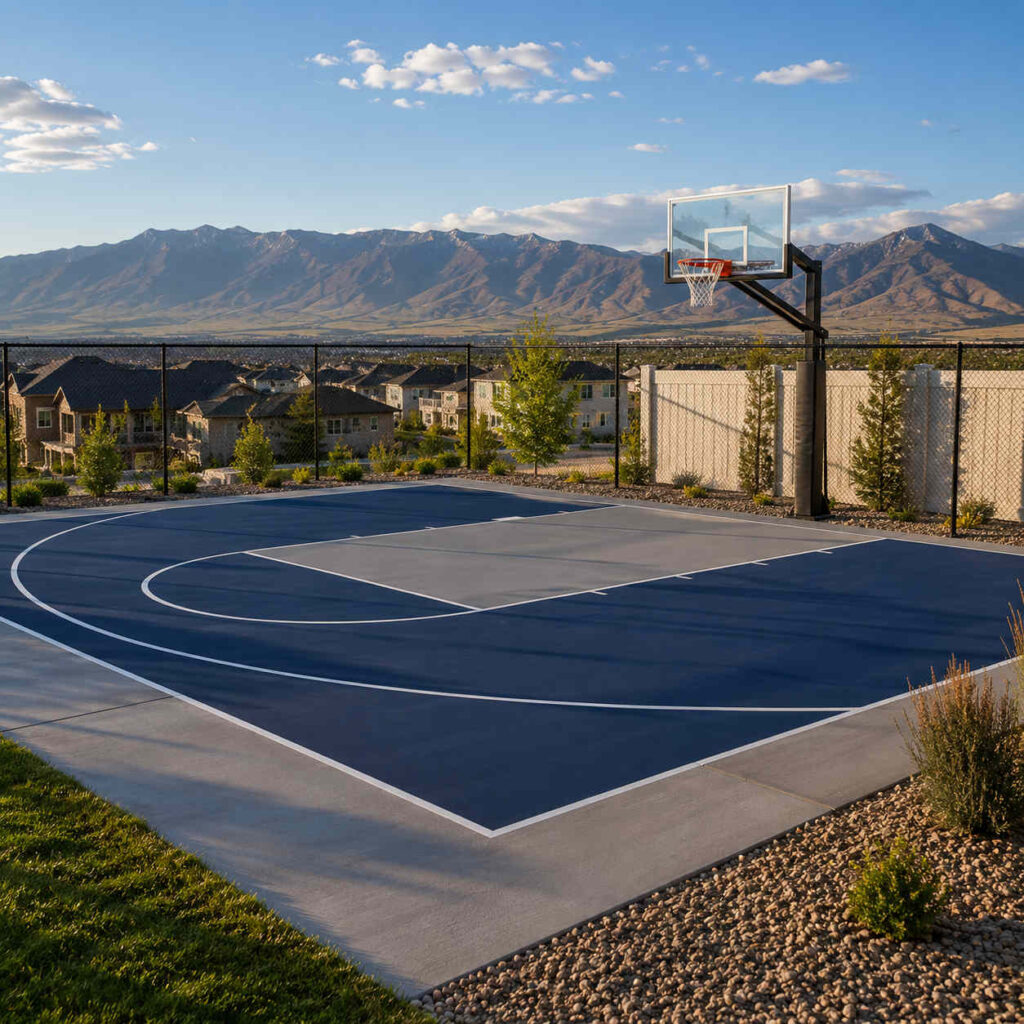
Color choices are wide. Standard sport court palettes include two-tone combinations of green, red, navy, gray, and tan. For Draper homes with premium exterior design, coordinating the court colors with the home’s exterior palette — or simply choosing neutral tones that don’t compete with the landscape — produces a result that looks considered rather than arbitrary. A contractor who has done residential courts throughout Draper and the surrounding area can show you completed examples at various ages, which is more useful than any color chart.
Hoop Setup: Embedded Sleeve vs. Bolt-Down vs. Portable
There are three ways to get a hoop on a concrete court, and the decision should happen before concrete is poured — not after.
Embedded in-ground sleeve: The cleanest and most permanent option. A steel sleeve is set in the concrete during the pour at the manufacturer’s specified depth. The hoop pole inserts into the sleeve and locks in place. Adjustable height systems are standard. In-ground hoops anchored with embedded sleeves provide the most stable playing experience — no movement, no flex, game-quality rigidity. This is the right choice for a serious practice setup in Draper. Decide on your hoop manufacturer before the pour so the contractor can set the sleeve at the correct specifications.
Epoxy-anchored post-pour installation: If the sleeve isn’t embedded during the pour, a post-pour anchor using epoxy adhesive into core-drilled concrete is a workable alternative. It’s more expensive and more disruptive than embedding during the pour, the connection is slightly less rigid than a true embedded sleeve, and it leaves visible core-drill evidence in the court surface. Acceptable, but not the preferred approach for a Draper court where the goal is quality.
Portable or bolt-down systems: Portable hoops work on any flat surface and require no concrete modification. For families who want flexibility or who aren’t ready to commit to a fixed location, this is a legitimate option. Bolt-down systems mount to surface anchors and are somewhat more stable than portables. Neither performs like a properly embedded in-ground system for serious play, but they’re serviceable for casual use and youth development.
Add-Ons Worth Considering for a Draper Court
Multi-sport lines: Pickleball has grown dramatically in Draper and across the Salt Lake Valley, and a court that accommodates both basketball and pickleball serves a broader range of users and ages. Volleyball court lines are another common addition. Multi-sport line packages are added during the sport coating application and cost $300 to $800 depending on the combination. If there’s any chance you’ll want pickleball on the same surface, plan for it before the coating is applied — adding lines to an existing coated surface costs more than including them in the initial coating job.
Fencing: Fencing around a residential basketball court is optional but practical for Draper properties where the court is adjacent to landscaping, neighboring lots, or slopes where balls disappear over the edge. Black vinyl-coated chain link on galvanized posts is the most common residential choice — it contains errant balls without visually dominating the yard. Heights typically run 8 to 10 feet on the back and sides, lower or open on the driveway approach. Fencing contractors typically work after the concrete cure and before the sport coating.
Lighting for evening play: Draper’s spring and fall evenings are genuinely ideal conditions for outdoor basketball. If evening play is part of the plan, electrical conduit run beneath or through the slab during construction saves the cost of trenching and patching later. Two to four light poles around a half court, properly positioned to minimize shadows across the court, run $2,500 to $6,000 installed depending on fixture quality and the electrical run distance. Plan it before the pour — the conduit placement is the decision that needs to happen at construction time.
Timing: When to Pour in Draper
Draper’s optimal concrete season runs April through October. Spring pours have the advantage of full-summer cure time before the court faces its first serious winter. The downside is that spring in Draper brings rain and temperature variability that requires watching the forecast carefully. Late summer pours — August and September — give you stable weather, warm nights that support overnight strength development, and a court that’s fully cured before the first hard freeze.
November through March is possible with cold-weather concrete procedures: heated mix water, accelerating admixtures, insulated curing blankets, and temperature monitoring through the cure period. The added complexity increases cost and narrows the scheduling window. For most Draper families without a specific deadline pressure, waiting for April produces a better result at lower cost.
Xpert Concrete & Seal builds basketball courts in Draper built to play well and hold up through Utah winters. Licensed, insured, and experienced throughout the Salt Lake Valley.
Call (385) 560-9123 for a free on-site estimate — we come out, walk the site, and put together a specific proposal for your Draper project
Frequently Asked Questions
What size basketball court fits in a Draper backyard?
Most standard Draper lots in neighborhoods like South Mountain, Highland Estates, and Suncrest can accommodate a 30-by-50-foot half court. Measure your usable flat area first, accounting for setbacks and landscaping. Smaller practice courts in the 28-by-35-foot range work on tighter lots. Confirm setback requirements with Draper City or your HOA before finalizing the layout.
How much does a basketball court cost in Draper, UT?
A standard 30-by-50-foot half court in Draper runs $10,000 to $16,000 for the concrete slab, plus $3,500 to $6,000 for sport coating and lines. Fencing and lighting are additional. Total installed project with coating, fencing, and basic lighting typically runs $18,000 to $28,000. Get written, itemized quotes with concrete specifications stated.
Do I need a permit to build a basketball court in Draper?
Requirements vary based on project scope and placement. The concrete slab itself may not require a permit depending on size and location, but fencing above certain heights typically does. Projects near property lines or easements trigger different requirements. Draper City’s planning and building department can confirm requirements for your specific layout.
How long does a concrete basketball court last in Draper?
A properly specified court — 4,000 PSI air-entrained concrete, adequate base, quality sport coating — lasts 25 to 30 years in Draper’s climate. The sport coating needs refreshing every 6 to 8 years. The concrete structure itself, properly maintained, outlasts the coating by decades.
Can I add a basketball court to an existing concrete slab?
If the existing slab is structurally sound, flat, and properly drained, a concrete overlay or direct sport coating application may be possible. If the slab has cracks, settlement, surface deterioration, or poor drainage, starting fresh with a properly designed court slab is typically the better long-term decision. Have a contractor assess the existing surface before committing to an overlay approach.
Does Xpert Concrete & Seal build basketball courts in Draper?
Yes. Xpert Concrete & Seal installs residential and commercial basketball courts throughout Draper and Salt Lake County. We build to the concrete specifications Draper’s Wasatch Front climate demands and can coordinate with sport surfacing and fencing contractors to deliver a complete, ready-to-play court. We serve all Draper neighborhoods including Suncrest, South Mountain, Corner Canyon, and Highland Estates.