
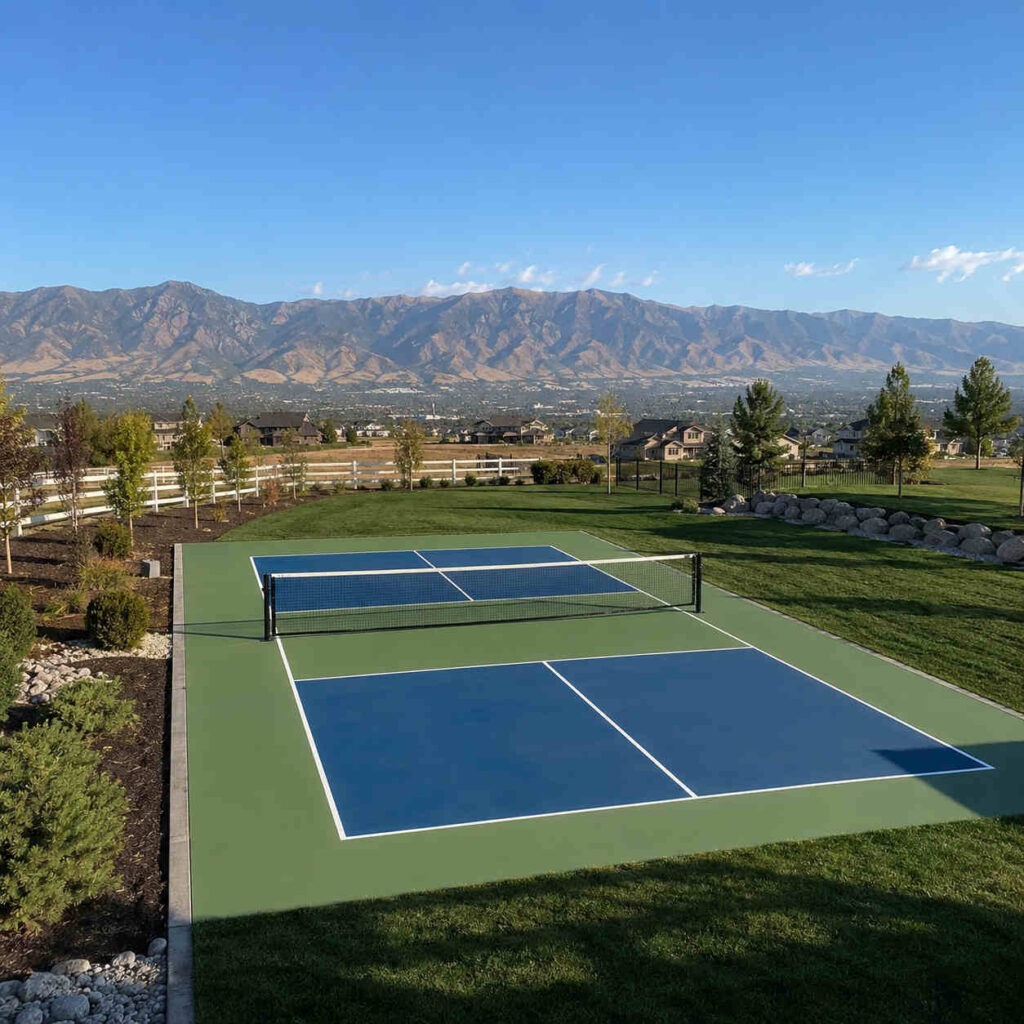
Backyard Pickleball Courts in Bluffdale, UT: A Large-Lot Homeowner’s Guide
Pickleball has been growing fast across Utah for several years, and Bluffdale is no exception. The courts at Bluffdale City Park stay occupied through spring, summer, and fall, and anyone who plays regularly knows that showing up without a reservation is increasingly a gamble. That’s one reason homeowners in Bluffdale’s River View neighborhoods and the large-lot developments along Redwood Road and 14400 South have started looking at their backyards differently — not as a problem to solve, but as an asset they’ve been underleveraging. A residential pickleball court is a genuinely attainable project in Bluffdale. The sport’s relatively small footprint — a standard court is 20 by 44 feet — means that what looks like a large-lot luxury is actually accessible on most Bluffdale properties. This guide covers what it takes to build a concrete pickleball court here, how to spec it for the valley’s southern climate, and what separates a court that plays well for 25 years from one that starts giving you problems after the third winter.
Why Bluffdale Properties Are Particularly Well-Suited for Pickleball Courts
The appeal of building a backyard pickleball court isn’t the same everywhere. In a city with small lots and tight setbacks, the math often doesn’t work. In Bluffdale, it almost always does. The city has one of the highest concentrations of large single-family lots in Salt Lake County, and a lot that seems modest by Bluffdale standards still has enough usable outdoor space to accommodate a court without sacrificing the yard’s other functions.
A regulation pickleball court — 20 feet wide and 44 feet long — sounds substantial until you compare it to what’s already sitting in most Bluffdale backyards. With recommended run-off space added, the total concrete pad runs about 30 by 60 feet. That’s 1,800 square feet of hardscape, which leaves plenty of room for a lawn, a patio, landscaping, and other features even on a standard Bluffdale lot. On the larger properties in the River View communities and the newer developments along Camp Williams Road, two courts side by side are a realistic option. Three courts — enough for a genuine mini-facility that serves a family, a neighborhood group, or regular hosted games — fits comfortably on the bigger parcels.
The Jordan River Parkway Trail runs along Bluffdale’s eastern edge and connects the city to the broader regional trail network. It’s the kind of outdoor amenity that attracts active, recreation-oriented residents. That same impulse — getting outside, staying active, playing with friends and family — is exactly what drives homeowners to build courts. Bluffdale’s culture and its lot sizes both point in the same direction.
Standard Pickleball Court Dimensions and Layout Options
Getting the dimensions right is where planning starts. The USA Pickleball Association specifies a regulation court at 20 feet wide and 44 feet long. The net divides the court at the center (22 feet from each baseline) at a height of 36 inches at the sidelines and 34 inches at center. The kitchen — the non-volley zone — extends 7 feet from each side of the net.
For a residential installation, the concrete pad extends beyond the court lines to provide run-off space. USA Pickleball recommends a minimum of 10 feet of run-off at each baseline and 7 feet on each sideline for recreational play. For serious competitive play or tournament hosting, 15 feet at the baselines is preferred. A standard residential pad with adequate run-off works out to approximately 30 by 60 feet for a single court. This is the size to plan around in Bluffdale.
Single court: 30 by 60 feet (1,800 sq ft). Fits almost any Bluffdale backyard with room to spare. The right choice for families and casual regular players.
Two courts side by side: 64 by 60 feet (approximately 3,840 sq ft). Allows four-player doubles games on each court simultaneously and can accommodate small group events or family tournaments. Fits comfortably on larger Bluffdale lots.
Converted from tennis court: A standard tennis court footprint (36 by 78 feet minimum) fits two to four pickleball courts depending on run-off space. If you have an existing tennis court on your Bluffdale property, conversion — either adding pickleball lines to the existing surface or replacing the slab entirely — is often the fastest path to playing.
Concrete Specification: What Utah’s Climate Requires
Bluffdale sits at the southern end of the Salt Lake Valley at roughly 4,400 feet elevation. The climate here is real Utah — hard winters with repeated freeze-thaw cycling, summer UV that’s intense at elevation, and the kind of temperature swings that stress outdoor concrete year after year. The specifications that make a pickleball court durable in this environment aren’t optional extras. They’re what separates a 25-year surface from one that starts deteriorating in year four.
Concrete mix: 4,000 PSI minimum compressive strength with air entrainment at 5 to 7 percent. Air entrainment is the spec that matters most for outdoor flatwork in Bluffdale’s climate. The microscopic air bubbles distributed through the paste give freezing water somewhere to expand without building the internal pressure that causes surface scaling and spalling. A pickleball court poured without air entrainment in Utah’s climate will hold up passably for a couple of seasons and then begin degrading at the surface in ways that affect both appearance and playability.
Thickness: 4 inches for a standard residential court. On Bluffdale lots where the soil beneath the proposed court area includes engineered fill from site grading, 5 inches is worth the modest additional cost. Thicker slabs handle edge loads and surface movement from ground settling more effectively.
Base preparation: Minimum 4 inches of compacted road base over properly compacted and stable subgrade. On any Bluffdale site where soil history is uncertain or where the lot was recently graded, base preparation is where you don’t cut corners. The base beneath the slab is what determines whether the finished surface stays flat and true over time — or develops low spots, surface waves, and eventually cracks as the ground beneath it consolidates unevenly.
Drainage slope: A consistent 1 percent slope across the court surface (approximately 1/8 inch per foot) in one direction sheds water effectively without affecting play. Standing water on a Bluffdale court in winter means ice. Ice means slip hazard and accelerated surface damage. Drainage slope is a detail that matters both for safety and for concrete longevity.
Surface finish: Steel trowel finish — smooth and consistent — is the required finish for a pickleball court. The ball’s behavior on the surface depends on consistent contact with a flat, textureless plane. A broom-finished court will play differently than a steel-troweled one, and not in a direction that improves the game. Confirm the finish specification with your contractor before the pour.
The Acrylic Coating: What Goes on After the Concrete
The concrete slab is the structural foundation of a pickleball court. The acrylic sport coating applied over it after full cure (28 days minimum) is what makes it a court. The coating does three things: it provides the surface texture that gives the ball its characteristic bounce and the players their footing, it delivers the color and line striping that define the court, and it acts as a UV-protective barrier that slows the surface degradation that high-elevation sun exposure causes on bare concrete.
Xpert Concrete & Seal handles the full concrete scope — grading, base prep, forming, pouring, and finishing. The acrylic coating is applied by a sport surfacing contractor after the concrete has cured. We coordinate with the surfacing contractor or can work alongside one you’ve already engaged. The sequence matters: the concrete must be fully cured before coating is applied. Coating over under-cured concrete leads to adhesion failure and premature peeling.
Color options for the coating are wide. Standard pickleball court palettes run to greens, blues, reds, and grays in two-tone combinations. For Bluffdale properties where the court is visible from the home, choosing colors that complement the house exterior and existing landscaping produces a finished result that reads as intentional rather than dropped into the yard.
Net Post Sleeves: Plan Them Before the Pour
Net posts on a residential pickleball court anchor into the ground at center court, one on each side of the net at the sideline. The cleanest installation approach is embedding the post sleeves during the concrete pour — the contractor sets them at the correct spacing (20 feet apart, centered on the court lengthwise) and pours the concrete around them. The posts drop in and lock into the sleeves when you’re ready to play, and pull out for storage when you’re not. This is the same approach used on good basketball court hoop installations, and the logic is the same: do it right during the pour rather than drilling and anchoring after the fact.
Portable net systems are available and work on any flat concrete surface without embedded sleeves. They’re a legitimate option for homeowners who want flexibility in how the court is used — particularly if the court is shared with other sports like volleyball or bocce. The trade-off is stability during play: embedded sleeves provide a more rigid, consistent net tension than portable systems.
Permits in Bluffdale
Permit requirements for residential sports courts in Bluffdale depend on the project scope and lot placement. The concrete slab itself may or may not require a permit depending on size and proximity to setbacks and easements. Fencing above certain heights requires a permit. Courts near the Jordan River corridor may have additional considerations based on flood plain or easement designations. Bluffdale City’s Community Development department can confirm requirements for your specific property. A contractor experienced with Bluffdale projects will identify the permit landscape during the estimate process rather than leaving it to you to figure out afterward.
Maintaining a Pickleball Court in Bluffdale
A properly built concrete pickleball court in Bluffdale is genuinely low-maintenance — which is part of its appeal over alternatives like portable or temporary court setups. The primary ongoing tasks are straightforward.
Sealing the acrylic coating: The sport coating on a Bluffdale court will need refreshing every 5 to 8 years depending on use intensity and UV exposure. The coating protects the concrete beneath it; when it wears through in high-traffic areas, those areas become exposed to the freeze-thaw cycles that damage concrete surfaces. A coating refresh is a professional surfacing job, not a DIY task, but it’s much less disruptive and expensive than repairing a deteriorated concrete surface.
Annual inspection: Walk the court after the first hard freeze each spring and note any surface changes — new cracking, areas where the coating has lifted, any sections where water clearly pooled and froze. Early attention to these issues, particularly crack filling before another winter arrives, prevents small problems from becoming large ones.
Cleaning: Periodic washing with a garden hose or pressure washer removes dirt, algae, and organic debris that accumulate on the surface. Salt Lake Valley dust storms deposit material on outdoor surfaces in summer, and the Jordan River corridor’s moisture creates conditions where algae can establish on unprotected surfaces. Keep the court clean and the coating intact, and the surface holds up with minimal intervention.
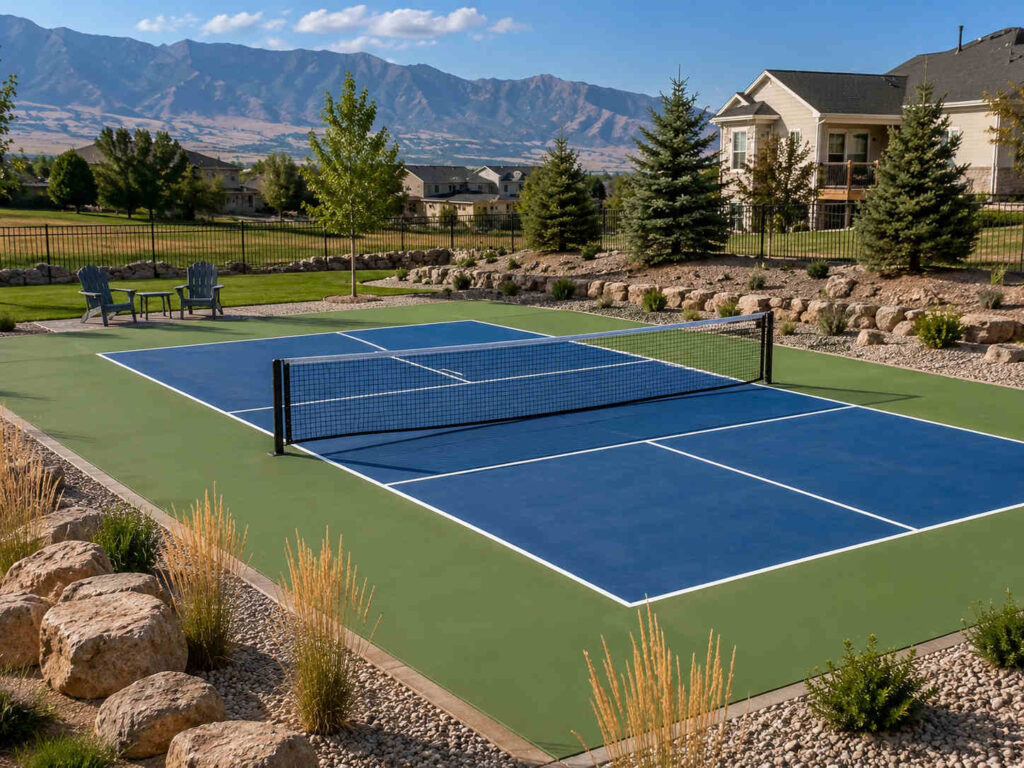
Xpert Concrete & Seal builds pickleball courts in Bluffdale on lots that were made for them. Licensed, insured, experienced throughout Salt Lake County.
Call (385) 560-9123 for a free on-site estimate we come out, walk your specific lot, and tell you exactly what fits and what it costs.
Frequently Asked Questions
How much does a pickleball court cost in Bluffdale, UT?
A single 30-by-60-foot concrete pickleball court pad in Bluffdale runs approximately $8,000 to $14,000 for the concrete work. Acrylic coating and line striping adds $3,000 to $5,500. Fencing and lighting are additional. Total project for a single court with coating runs approximately $11,000 to $20,000 depending on scope and site conditions. Multi-court layouts reduce the per-court cost as fixed mobilization and base costs spread across more area.
How much space does a pickleball court take in a Bluffdale backyard?
A single court with run-off requires approximately 30 by 60 feet (1,800 square feet). Most Bluffdale lots can accommodate this comfortably. The small footprint relative to Bluffdale’s lot sizes is genuinely one of pickleball’s advantages for residential installation in this community.
Can I convert my existing tennis court to pickleball in Bluffdale?
Yes. A standard tennis court footprint accommodates two to four pickleball courts. If the existing concrete is in good condition — structurally sound, reasonably flat, no significant cracking or settling — adding pickleball lines to the existing surface (either painted or as part of a new acrylic coating layer) may be all you need. If the existing slab is deteriorated, a new pour is the better long-term investment.
How long does a concrete pickleball court last in Utah?
25 to 30 years for the concrete structure with proper specification and maintenance. The acrylic sport coating needs refreshing every 5 to 8 years. Net posts and hardware require inspection and occasional replacement as they weather. The concrete itself, properly maintained, outlasts almost everything else on the property.
Can I add a basketball hoop to my pickleball court?
Yes. Multi-sport courts that combine pickleball lines with a basketball key and hoop are common and make efficient use of a single concrete pad. If you want basketball capability, plan the multi-sport layout before the pour — the hoop sleeve and any additional line striping are easiest to coordinate during initial construction.
How long does the construction take for a pickleball court in Bluffdale?
The concrete phase of a single court typically completes in one to two days of active work. Concrete then needs 7 days minimum before foot traffic and 28 days before acrylic coating can be applied. From initial concrete pour to a coated, playable court, plan for approximately five to six weeks total — the majority of which is cure time, not active construction.
Does Xpert Concrete & Seal build pickleball courts in Bluffdale?
Yes. Xpert Concrete & Seal installs residential and commercial pickleball courts throughout Bluffdale and Salt Lake County. We handle the full concrete scope — site preparation, grading, base prep, forming, pouring, and finishing — and coordinate with sport surfacing contractors for coating and line striping. We serve all Bluffdale neighborhoods including River View, the 14400 South corridor, and developments along Camp Williams Road and Mountain View Corridor.