
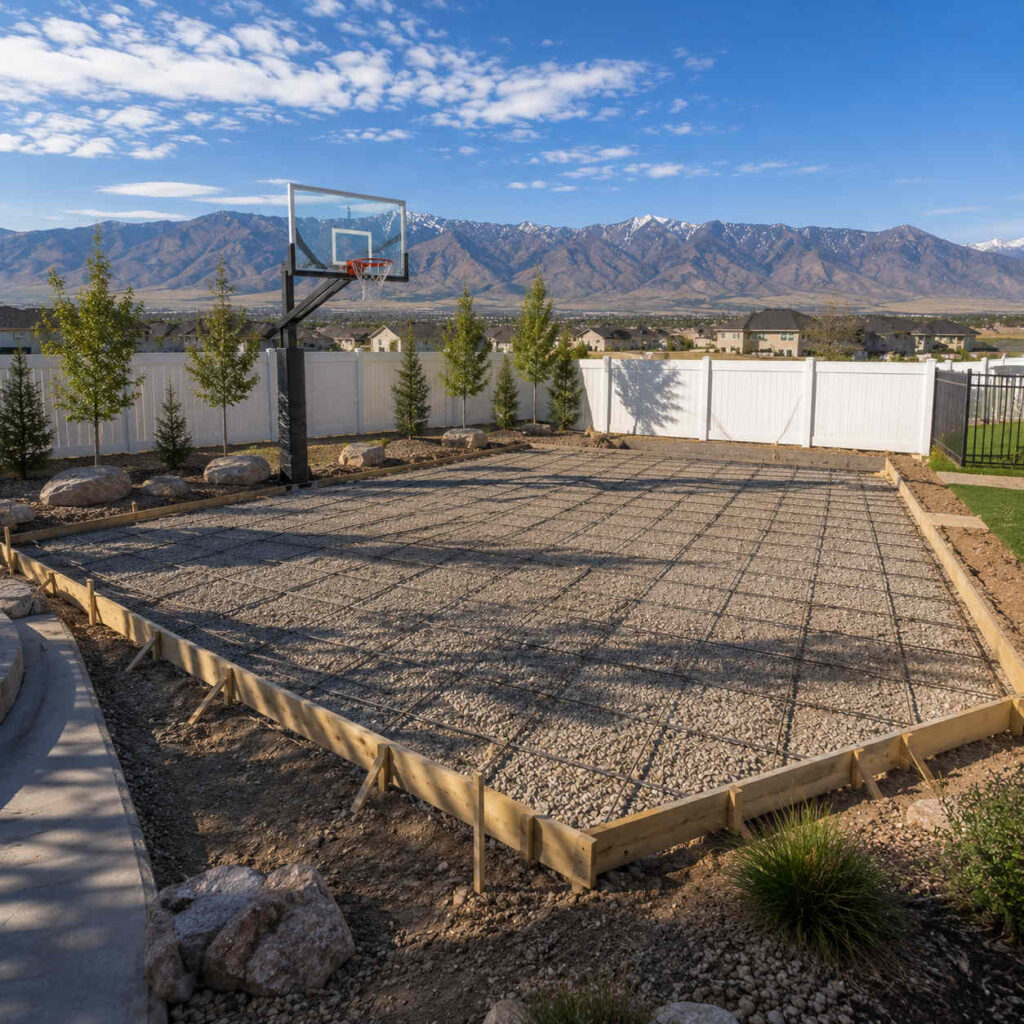
The first quote most Eagle Mountain homeowners get for a backyard basketball court lands somewhere between “that’s more than I expected” and “that can’t be right.” Both reactions are reasonable, because the range of what a basketball court installation actually costs in Utah County is wide — and without knowing what drives that range, it’s impossible to evaluate whether a quote is fair or whether you’re being overcharged or underserved.
This guide breaks down what a concrete basketball court costs in Eagle Mountain in 2025, what adds to that number, what reduces it, and where the shortcuts that look like savings on quote day turn into problems on year three.
Basketball Court Pricing in Eagle Mountain: The Baseline Numbers
In the Eagle Mountain and broader Utah County market in 2025, concrete basketball court installation runs in these ranges:
Small practice court (30×30 ft / 900 sq ft): $6,500 to $10,500 for the concrete slab. Add $2,500 to $4,500 for sport coating and lines. Total installed range with coating: $9,000 to $15,000.
Standard half court (30×50 ft / 1,500 sq ft): $10,000 to $16,000 for the concrete. $3,500 to $6,000 for coating. Total installed with coating: $13,500 to $22,000.
Large half court (40×60 ft / 2,400 sq ft): $15,000 to $24,000 for the concrete. $5,000 to $8,000 for coating. Total with coating: $20,000 to $32,000.
Full regulation court (50×84 ft / 4,200 sq ft): $26,000 to $42,000 for the concrete. $8,000 to $13,000 for coating. Total with coating: $34,000 to $55,000+.
These ranges reflect 2025 labor and material costs in the Eagle Mountain area. Ready-mix concrete, base materials, and labor have all moved significantly since 2022 — quotes from two years ago are not reliable reference points for today’s market.
What Drives Pricing Up in Eagle Mountain
Site access: Ready-mix trucks are large. If the court site requires the truck to reach across a fence line, down a narrow side yard, or across landscaping that limits truck positioning, a concrete pump is needed. Pumping adds $800 to $1,500 to a typical residential project. When you’re describing your project to a contractor, mention the access situation early — it affects the estimate and the pour day logistics.
Excavation and base depth: Eagle Mountain’s newer neighborhoods have significant areas of engineered fill soil. Fill that hasn’t fully consolidated requires deeper base preparation to achieve stable bearing capacity. Some court sites need 6 to 8 inches of compacted road base rather than the standard 4 — that adds material and compaction passes, both of which show up in the quote. Contractors who skip this assessment and quote a flat base depth regardless of soil conditions are either assuming good soil or cutting corners. Ask specifically what base depth they’re quoting and why.
Concrete specification: A 4,000 PSI air-entrained mix appropriate for Eagle Mountain’s climate costs more per yard than a basic 3,000 PSI non-air-entrained mix. The difference works out to $3 to $6 per square foot over the life of the court — air-entrained courts last significantly longer in Cedar Valley’s freeze-thaw environment. Quotes that come in noticeably lower than others are often reflecting a cheaper mix, not a more efficient contractor.
Thickness: Going from 4-inch to 5-inch slab thickness adds roughly $0.80 to $1.20 per square foot in concrete cost. For a 1,500 square foot half court, that’s $1,200 to $1,800. Whether it’s worth it depends on your soil — fill soil or known soft spots warrant the extra inch; solid compacted native soil typically doesn’t require it.
Hoop anchor sleeve: An in-ground adjustable hoop requires a steel sleeve embedded during the concrete pour. The sleeve itself costs $150 to $400 depending on manufacturer, and installation during the pour is straightforward. Having it installed correctly the first time costs less than core drilling and anchoring afterward.
Add-On Costs: Sport Coating, Fencing, and Lighting
Sport coating (acrylic court surfacing): The colored coating applied over cured concrete. Material and labor in Eagle Mountain runs $2.00 to $3.50 per square foot for a standard two-color application with court lines. A 1,500 square foot half court runs $3,000 to $5,250 for coating. Premium multi-sport line packages (adding pickleball, volleyball, or four square lines) add $300 to $800. The coating is optional but strongly recommended — it protects the concrete surface, provides better traction than bare concrete in wet or icy conditions, and makes the court look finished rather than industrial.
Chain link fencing: $18 to $28 per linear foot installed, depending on height and vinyl coating. A fenced perimeter for a standard half court (roughly 160 linear feet) runs $2,900 to $4,500. Not everyone fences a residential court — it depends on lot layout and how contained you want errant balls to be. In Eagle Mountain’s tight neighborhoods along Pony Express Parkway where lots abut other yards, fencing is practical. On large Cedar Valley lots with open space, it’s more of a preference.
Lighting: Post lighting for evening play requires electrical work that’s easiest to plan before the slab is poured. Two to four light poles around a half court, wiring, and fixtures typically run $2,500 to $6,000 depending on fixture quality and the electrical run distance to your panel. Having conduit embedded under the slab during construction saves $500 to $1,500 compared to trenching and patching after the fact.
What Looks Like Savings But Isn’t
Basketball court quotes vary for reasons beyond contractor efficiency. When a quote comes in $3,000 to $5,000 lower than the others, it’s worth understanding why before assuming you’ve found the best value. The most common shortcuts that produce lower quotes in Eagle Mountain:
Non-air-entrained concrete: Saves $1 to $2 per square foot upfront. In Cedar Valley’s freeze-thaw environment, a non-air-entrained surface starts scaling noticeably within 3 to 5 seasons. The money saved on spec is recovered in repair costs — or more likely, in a full resurfacing project on a timeline that surprises the homeowner.
Skipping or minimizing base preparation: A 2-inch base instead of 4 inches, or base compaction without verification. Saves $800 to $1,500 on a standard half court. On Eagle Mountain’s fill soils, an inadequate base is the leading cause of courts that develop humps and low spots as the ground beneath consolidates. A flat court on installation day becomes an uneven court within a few years.
Thin slab: 3-inch concrete instead of 4-inch. Saves material cost but produces a slab that’s more susceptible to cracking under the edge loads and impact loads that courts experience, particularly in the freeze-thaw cycling Eagle Mountain gets through winter.
No permit: Saves permit fees but creates complications at resale and leaves you without recourse if the court needs to be modified or removed due to easement or setback violations discovered later.
What a Basketball Court Actually Costs Over 20 Years in Eagle Mountain
The right way to evaluate a basketball court investment in Eagle Mountain isn’t the install price — it’s the 20-year total cost of ownership. A properly specified court (4,000 PSI air-entrained concrete, 4-inch slab, quality base, sport coating) installed for $16,000 on a half court will need a coating refresh every 6 to 8 years ($2,500 to $4,000 per refresh) and minimal other maintenance. Total 20-year cost: roughly $20,000 to $24,000. A cut-rate court installed for $11,000 with inferior spec will likely need resurfacing or significant repair within 5 to 7 years, adding $5,000 to $12,000 in remediation costs. The less expensive quote isn’t always the cheaper court.
Frequently Asked Questions
What does a half court basketball court cost in Eagle Mountain, UT in 2025?
A standard 30×50 foot half court in Eagle Mountain runs $13,500 to $22,000 for concrete plus sport coating installed. Fencing and lighting are additional. The wide range reflects site conditions, concrete specification, and contractor.
Is sport coating required on a basketball court?
No, but it’s strongly recommended in Eagle Mountain’s climate. The coating protects the concrete from UV degradation and freeze-thaw surface damage, provides better traction than bare concrete, and gives the court its finished appearance with painted lines. Courts without coating look like slabs and deteriorate faster.
How long does a concrete basketball court last in Eagle Mountain?
25 to 30 years for the concrete structure with proper specification. The sport coating requires refreshing every 6 to 8 years. Fencing may need attention at 10 to 15 years depending on post condition and hardware.
Can I add a court in phases to spread the cost?
The concrete slab needs to be poured complete — you can’t pour half a court and add the other half cleanly later without a visible cold joint. However, you can pour the full slab now and add sport coating, fencing, and lighting as budget allows. The concrete itself is the investment that needs to be done right the first time.
Does Xpert Concrete & Seal provide free estimates for Eagle Mountain basketball courts?
Yes. Xpert Concrete & Seal provides free on-site estimates for basketball court projects throughout Eagle Mountain and Utah County. We come out, walk the site with you, and put together a specific proposal — not a ballpark from a phone call.
What should I ask when getting basketball court quotes in Eagle Mountain?
Ask: What PSI concrete and is it air-entrained? What base depth are you quoting and why? Does the price include hoop sleeve installation? Are permits included in your scope? Can I see photos of completed courts you’ve built in Utah County at 2 or more years post-installation?
Get a straight quote with real specs. Xpert Concrete & Seal serves Eagle Mountain, Saratoga Springs, Lehi, and all of northern Utah County. Call (385) 560-9123 to schedule a free on-site estimate for your backyard basketball court.