
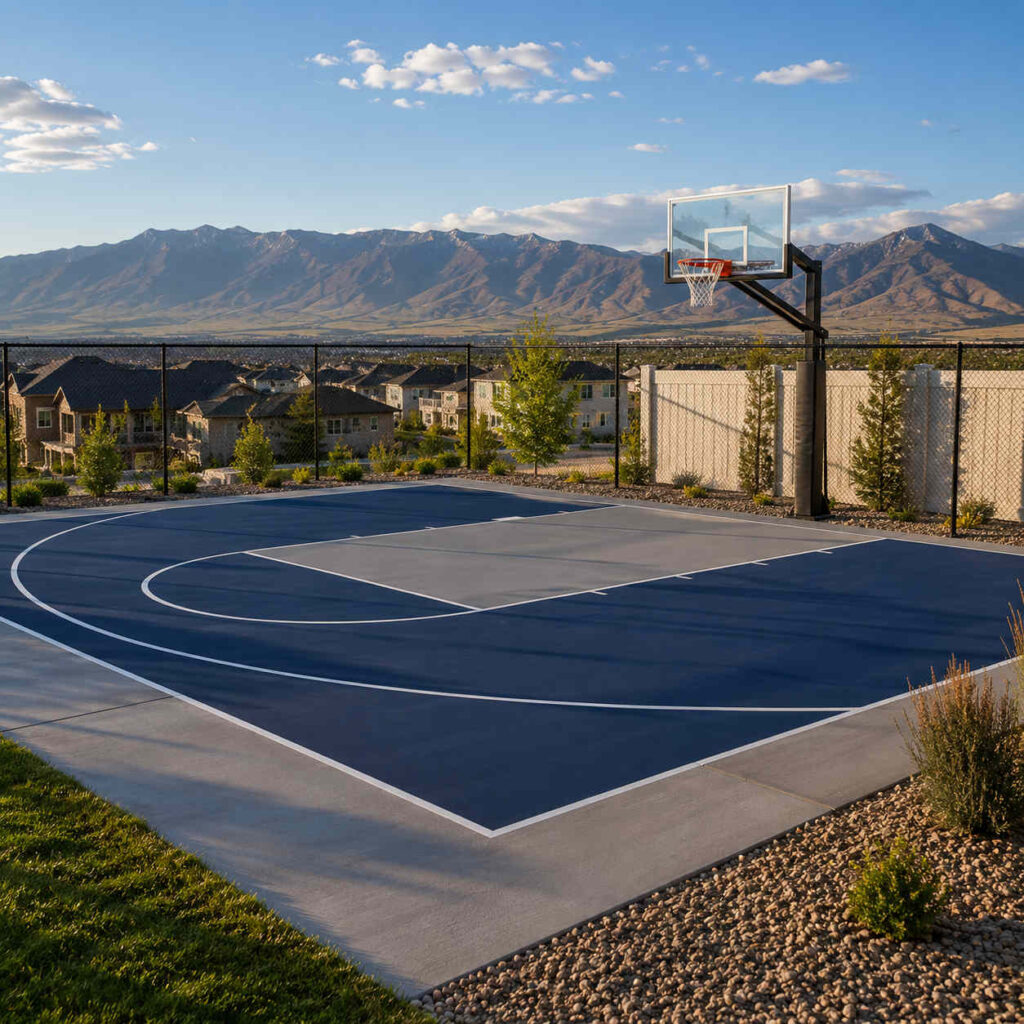
Eagle Mountain is one of the best cities in Utah County to build a backyard basketball court, and that’s not a marketing line. The city has large lots by Utah suburban standards, an active youth sports culture that runs through Eagle Mountain Parks and Recreation year-round, and a density of young families that means a backyard court rarely sits idle. Build one and within a week the neighbors’ kids know about it. Within a month it’s a fixture. The question most Eagle Mountain homeowners have isn’t whether to build — it’s how to build one that holds up through Cedar Valley winters and actually plays well, rather than a slab that looks right in April and starts cracking by December.
This guide covers the decisions that determine whether your Eagle Mountain basketball court is still a quality surface in year 10 or a maintenance headache you’re regretting by year 3.
Size: What Your Yard Can Fit and What You Actually Need
A regulation NBA court is 94 by 50 feet. Almost no residential backyard in Eagle Mountain has that footprint, and frankly most homeowners don’t need it. A half court — the practical standard for residential installations — runs approximately 47 by 50 feet for a true half-regulation setup, or as small as 30 by 30 feet for a simple driveway-style shooting court. The right size depends on what you plan to do with it.
30×30 to 30×40 feet: A shooting and practice court. Room for a hoop, free throw line, and a few players working on their game. No room for a real 5-on-5 run, but plenty of space for youth practice and casual shooting. This size fits most Eagle Mountain backyards without consuming the entire yard.
30×50 feet (standard half court): The most popular size for Eagle Mountain families. Fits a proper half-court setup with three-point arc, lane markings, and enough room for a real 3-on-3 or 4-on-4 game. If your lot permits this footprint, it’s worth the extra concrete — it’s the size that keeps getting used as kids get older and more serious.
50×84 feet (full court): A genuine full court with two baskets and room for the real game. Requires significant lot space and investment, but for large Cedar Valley lots or homes where multiple families will share access, it’s a legitimate option. Less common in residential builds but not rare in Eagle Mountain’s newer developments with generous square footage.
One practical note: measure your backyard now, before planning anything else. Include setbacks from the property line, any utility easements, and clearance from fences and structures. Eagle Mountain’s standard residential lots are larger than average for Utah County, but “large lot” and “enough room for a half court” aren’t always the same thing. Confirm the footprint first.
Concrete Specifications: Why Cedar Valley’s Climate Changes the Equation
A basketball court built to the same specs you’d use in Phoenix or the lower Salt Lake Valley will underperform in Eagle Mountain. Cedar Valley sits at roughly 4,900 feet elevation — noticeably higher and colder than the valley floor — and the combination of hard freeze-thaw cycling through winter and intense UV exposure in summer creates a specific durability challenge for outdoor concrete surfaces. The courts that fail prematurely in Eagle Mountain almost always trace back to one of two spec decisions: wrong concrete mix or inadequate base preparation.
Concrete mix: 4,000 PSI minimum compressive strength with air entrainment at 5 to 7 percent. The air entrainment is the critical spec for Cedar Valley. Those microscopic bubbles distributed through the paste give freezing water room to expand without building the internal pressure that flakes and pits a surface. Contractors who pour outdoor sports courts without air-entrained concrete in Utah County are either not paying attention to the climate or cutting costs at your expense.
Thickness: 4 inches minimum for a residential basketball court. 5 inches is worth considering if your yard has fill soil or known soft spots — thicker slabs distribute loads more effectively and handle edge loads from boundary lines and equipment better. Eagle Mountain’s newer developments have significant areas of engineered fill soil that can consolidate over time, making the extra inch a reasonable investment.
Base preparation: This is where most cut-rate court installations fail. Minimum 4 inches of compacted road base beneath the slab, placed over compacted and stable subgrade. In Eagle Mountain’s fill soil areas, this step needs extra care — an improperly compacted base is what causes basketball courts to develop humps, low spots, and cracks within a few seasons as the soil beneath moves. A flat, true playing surface on day one is only possible if the base beneath it is flat and true.
Drainage slope: Courts need a 1 to 2 percent slope (about 1/8 inch per foot) to drain water off the surface. Standing water on an outdoor court means icy patches in winter, algae growth in spring, and accelerated concrete deterioration over time. The slope is barely perceptible during play — you won’t notice it on the court, but you’ll notice the difference between a surface that drains and one that doesn’t.
Surface Finish and Court Coating: The Difference Between a Slab and a Court
The concrete surface itself is installed with a steel trowel finish — smooth, consistent, without the texture you’d use on a patio or walkway. That smooth surface is what gives a basketball its true bounce. A broom-finished concrete court will play rough and uneven because the aggregate texture interferes with ball behavior. Get the finish right and the court plays like a court. Get it wrong and it plays like a parking lot.
Most Eagle Mountain homeowners take the next step and add a colored acrylic sport coating over the cured concrete. This is a two-component system — a base coat and a color coat — applied by a sport surfacing contractor after the concrete has cured for 28 days. The coating adds three things: traction (the acrylic texture provides better grip than bare concrete in all conditions), visual definition (court lines embedded in the coating are clean and durable), and UV protection (the coating slows the color fading and surface degradation that bare concrete experiences under Eagle Mountain’s high-elevation sun). The concrete contractor typically coordinates with the sport coating applicator, or the homeowner can engage them separately.
Color options are wide. Standard court colors are green, red, blue, and tan with contrasting lane and key markings, but custom color combinations are available. For Eagle Mountain homes where the court will be visible from the street or adjacent living areas, choosing colors that complement the home’s exterior and landscaping makes a difference in the finished look.
Hoops, Fencing, and Lighting: What to Plan For Before the Pour
The hoop anchor needs to be addressed before concrete is poured, not after. An in-ground adjustable hoop requires a sleeve or anchor post set in the concrete during the pour — typically a 4-inch schedule 40 steel sleeve embedded to the manufacturer’s specified depth. Trying to add an in-ground hoop anchor to an existing slab requires core drilling and epoxy anchoring, which works but adds cost and never quite looks as clean as a properly embedded sleeve. Decide on your hoop before you finalize the court layout.
Fencing is optional but common in Eagle Mountain’s tighter neighborhoods — it keeps errant balls in the yard and defines the court perimeter. Chain link on galvanized posts is the practical choice for a residential court. Vinyl-coated black chain link is the aesthetic choice for homeowners who want something that blends into the yard rather than announcing itself. Fencing contractors can typically be scheduled after the concrete cures and before the sport coating is applied.
Lighting, if you want to use the court after dark — and in Eagle Mountain where evenings cool off and become very pleasant through late spring and fall, you will — is easiest to plan before the slab is poured. Conduit for electrical runs can be embedded in or under the slab during construction, saving the trenching and patching that’s required to add lighting after the fact. Coordinate with a licensed electrician before the pour if evening play is part of the plan.
Permits: What Eagle Mountain Requires
Eagle Mountain City permit requirements for residential sports courts vary based on the scope of the project. The concrete slab itself may or may not require a permit depending on size and location on the lot — structures near easements or property lines trigger different rules than courts centered in a large backyard. Fencing above a certain height typically requires a permit. Lighting may trigger electrical permit requirements. During the estimate process, a contractor experienced with Eagle Mountain projects will identify what’s required for your specific layout. Projects that skip permits create complications at resale and occasionally require modification or removal when they come to light during a sale.
Frequently Asked Questions
What is the minimum lot size needed for a half court in Eagle Mountain?
A standard half court (30×50 feet) requires roughly 1,500 square feet of usable flat yard space, plus setback clearance from property lines, easements, and structures. Most standard Eagle Mountain residential lots can accommodate a half court with room to spare — confirm your specific dimensions before planning the layout.
How long before we can play on the new court?
Light use starts at 7 days. Avoid heavy play or acrylic coating application for the full 28-day cure period. Concrete continues gaining strength through that window, and applying a sport coating to under-cured concrete leads to adhesion problems.
Can you add pickleball or other sport lines to a basketball court?
Yes. Pickleball, volleyball, four square, and other sport markings can be included in the court coating layout or painted on afterward. Multi-sport courts are common in Eagle Mountain given the city’s active recreation culture — plan the line layout before the coating is applied.
How does a concrete court hold up to Eagle Mountain winters?
An air-entrained 4,000 PSI concrete slab with a quality sport coating holds up very well through Cedar Valley winters. The coating protects the surface from direct freeze-thaw damage, and the air-entrained concrete resists the internal pressure that causes surface scaling on non-air-entrained slabs. Annual inspection for joint sealant condition and prompt crack filling if any develop are the primary maintenance tasks.
Do I need to seal a basketball court in Eagle Mountain?
If you have a bare concrete court without sport coating, yes — apply a penetrating sealer or acrylic topcoat. If you have a sport-coated surface, the coating itself serves the protective function. Reapply the sport coating when it shows significant wear, typically every 5 to 8 years depending on use intensity and UV exposure.
Does Xpert Concrete & Seal build basketball courts in Eagle Mountain?
Yes. Xpert Concrete & Seal installs residential and commercial basketball courts throughout Eagle Mountain, Utah County, and the greater Salt Lake Valley. We handle the concrete work, can coordinate with sport coating and fencing contractors, and build every court to Cedar Valley’s climate requirements.
Xpert Concrete & Seal builds basketball courts in Eagle Mountain built for how the game is actually played — and for how Utah winters actually perform. Call (385) 560-9123 for a free on-site estimate. We serve Eagle Mountain, Saratoga Springs, Lehi, and all of northern Utah County.