
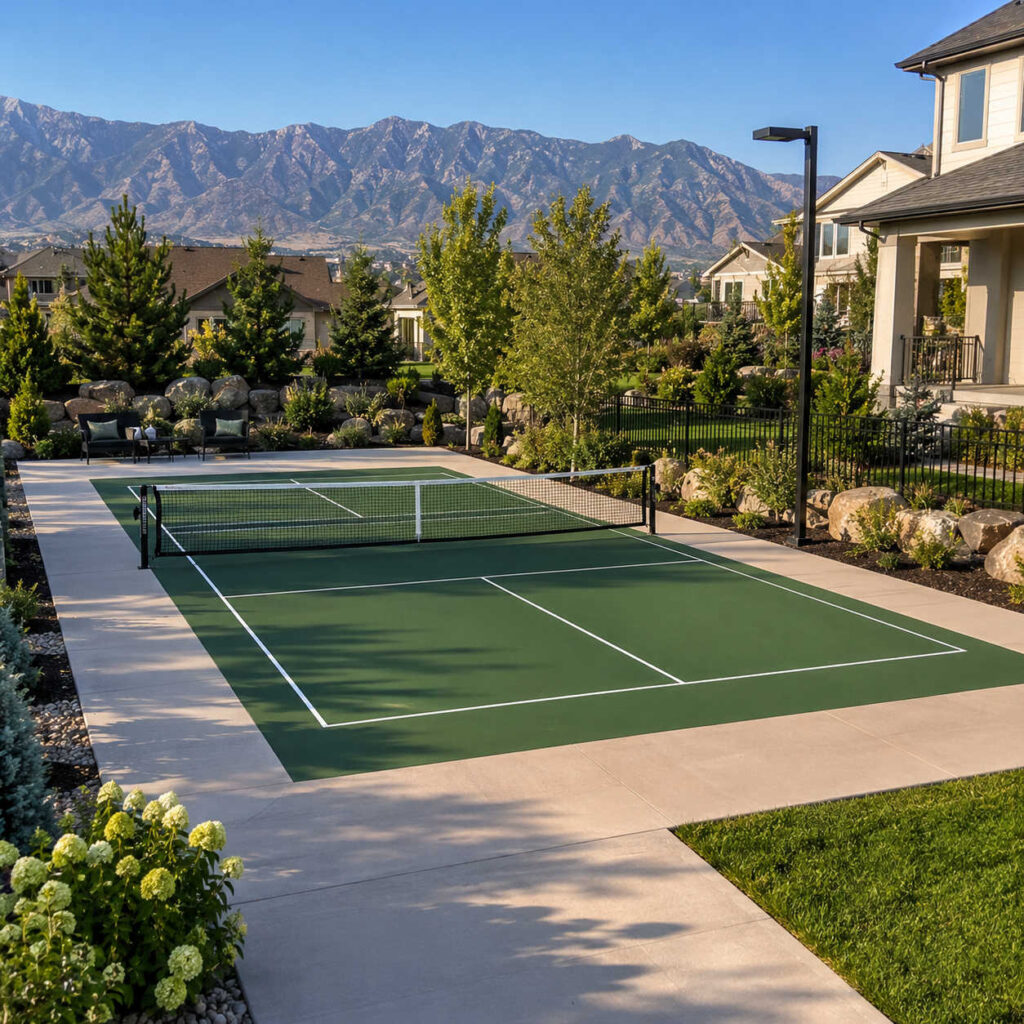
Can You Fit a Pickleball Court in Your Draper Backyard? Here’s What You Need to Know
A standard pickleball court is 20 feet wide by 44 feet long — and with recommended run-off space, you’re looking at a concrete pad around 30 by 60 feet. Most Draper backyards can accommodate at least one court, and many larger lots in neighborhoods like SunCrest, South Mountain, and Traverse Mountain can fit two side by side. If you’ve been eyeing the public courts at Wheadon Farm Park or paying monthly fees at Peak Pickleball on Draper Parkway, a private backyard court might be closer to reality — and better for your budget long-term — than you think.
At Xpert Concrete & Seal, we handle the full concrete scope for pickleball courts across the Salt Lake Valley, including Draper. Here’s what the process looks like, what it costs, and how to get it right the first time in Utah’s climate.
Why Draper Homeowners Are Building Private Pickleball Courts
Pickleball has taken off across Utah’s Wasatch Front, and Draper is no exception. The city currently has over 45 courts tracked across public venues and private clubs, but demand consistently outpaces availability. Court times at indoor facilities like Peak Pickleball fill quickly, public courts at Suncrest Park and Draper Senior Center have limited access, and league play means even fewer open windows for casual games.
Draper’s housing stock is the other factor. With a majority of homes built since 2000, large lots in planned communities, and a median home value well above $800,000, many Draper homeowners are already investing in outdoor living — covered patios, pools, and landscape upgrades. A pickleball court is a natural extension of that, and it adds genuine amenity value that buyers notice.
The result: more Draper residents are calling us to build permanent courts in their backyards rather than chasing court time across town.
What Does a Pickleball Court Installation in Draper Actually Cost?
This is the question most homeowners want answered first, so here it is directly:
| Component | Typical Cost Range |
| Concrete base (single court, 30×60 ft) | $6,000 – $10,000 |
| Acrylic court coating + line striping | $3,000 – $6,000 (sport surface contractor) |
| Site prep / grading (varies by slope) | $500 – $3,000+ |
| Net system | $200 – $800 |
| Total estimated range (single court) | $9,700 – $19,800 |
Note: These are ballpark ranges for a standard Draper residential build. Actual quotes depend on your lot’s slope, soil conditions, access, and finish preferences. Xpert Concrete & Seal provides free on-site estimates.
The split between the concrete contractor and the sport surface contractor is worth understanding. Xpert Concrete & Seal builds the structural base — grading, forming, pouring, and finishing. Once the concrete is cured (typically 28 days), a separate sport surfacing contractor applies the acrylic color coat and paints the official lines. We’re happy to coordinate with a surfacing partner or work with a contractor of your choice.
Utah’s Climate Makes the Concrete Base Critical
Draper sits at around 4,500 feet in elevation. That means genuine freeze-thaw cycles every winter — water works into any crack or void in your slab, expands when it freezes, and slowly destroys the surface from underneath. A poorly poured concrete base won’t survive more than a few Utah winters before you’re dealing with heaving, cracking, and a surface that can’t hold the acrylic coat properly.
This is why the concrete phase isn’t where you cut corners. A proper pickleball court base in the Draper area needs:
- Correct subgrade compaction — the soil under the slab has to be stable and graded for drainage
- Adequate thickness — 4 inches is a typical minimum for residential; we’ll recommend based on your soil
- Control joints — properly placed to manage natural cracking and protect surface integrity
- Smooth, broom finish — the right texture for the acrylic coat to bond correctly
We’ve seen what happens when a court is built too thin or without proper drainage planning. The surface looks fine at first, then fails after the second or third freeze. Getting the concrete right from the start is far cheaper than replacing a slab that wasn’t built for Utah’s conditions.
How Much Space Do You Actually Need?
One of the most common misconceptions homeowners have is that pickleball requires a tennis court-sized footprint. It doesn’t.
Here’s a quick sizing guide for Draper lots:
| Court Configuration | Concrete Pad Size | Approx. Sq. Ft. |
| 1 court (tight, residential) | 24 × 54 ft | 1,296 sq. ft. |
| 1 court (standard w/ run-off) | 30 × 60 ft | 1,800 sq. ft. |
| 2 courts side by side | 54 × 60 ft | 3,240 sq. ft. |
| 4 courts (HOA / commercial) | 60 × 120 ft | 7,200 sq. ft. |
Most established Draper neighborhoods — South Mountain, Steeplechase, and the larger lots along Highland Drive and Corner Canyon — can comfortably fit at least one standard court. If you’re in a newer build near The Point or along Pioneer Road, we’ll walk the space with you before committing to a layout.
For HOAs in Draper looking to add a pickleball amenity: a two-court setup fits within a standard tennis court footprint, which makes it a popular conversion for communities whose tennis courts are underused. We’ve done multi-court commercial installs throughout the Salt Lake Valley and can scope your project from initial grading through finished slab.
What the Build Process Looks Like
Here’s the typical timeline for a single residential pickleball court in Draper:
| Phase | Details |
| Week 1 — Site Visit + Quote | We walk your property, measure available space, assess slope and drainage, and put together a written estimate. No guesswork. |
| Week 2–3 — Scheduling + Permits | Most residential court builds in Draper don’t require permits beyond what the city requires for concrete flatwork — we’ll flag if yours does. |
| Build Day(s) — 1 to 2 days | Grading, forming, pouring, and finishing. Weather and site access are the primary variables. |
| Cure Period — 7 to 28 days | Concrete needs to fully cure before the acrylic coat is applied. We’ll let you know when it’s ready for the surface contractor. |
| Surface + Lines — 1 to 2 days | Applied by the sport surfacing contractor after cure. You’re playing within a day of that. |
From first call to first serve, most Draper residential builds are complete within 4 to 8 weeks depending on scheduling and cure time.
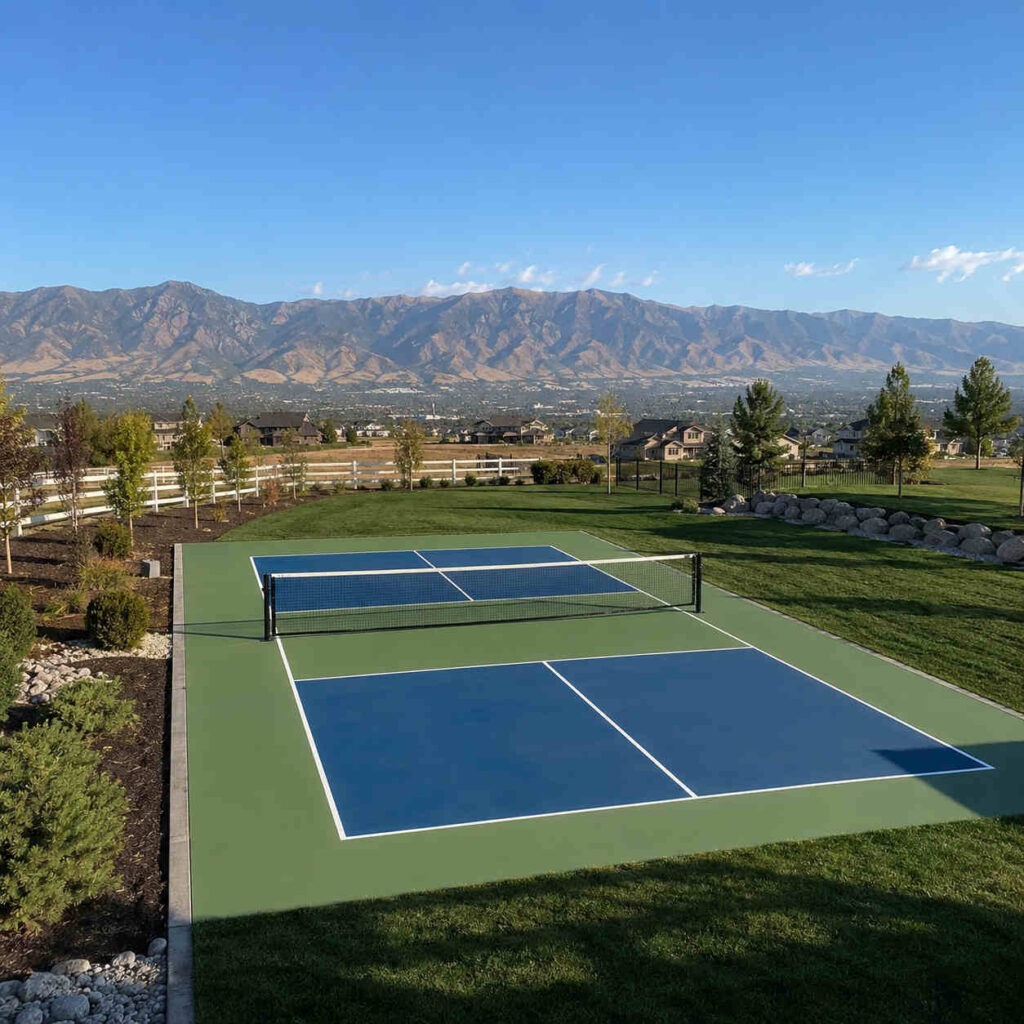
Build Your Draper Pickleball Court With Xpert Concrete & Seal
Draper homeowners trust Xpert Concrete & Seal for residential and commercial pickleball court installs throughout the Salt Lake Valley. We handle the full concrete scope — site prep, grading, forming, pouring, and finishing — and we build it right for Utah’s freeze-thaw winters.
Call (385) 560-9123 | Request a Free Estimate Online
Frequently Asked Questions
How much does a pickleball court cost in Draper, Utah?
A complete pickleball court in Draper — concrete base plus acrylic surfacing and lines — typically runs between $9,700 and $19,800 for a single residential court. The concrete base alone is usually $6,000–$10,000 depending on site conditions, and the sport surface coating adds another $3,000–$6,000 through a surfacing contractor. Larger lots building two or more courts see a lower cost per court.
Do I need a permit to build a pickleball court in Draper?
It depends on the project scope. Basic concrete flatwork for a backyard court typically doesn’t require a separate permit in Draper, but adding fencing, lighting, or a shade structure may trigger additional permits. We’ll review your project during the site visit and flag any requirements.
Can I build a pickleball court on a sloped backyard?
Yes, but grading work adds to the cost. Significant slope means more excavation and base prep to achieve the level, draining surface a pickleball court requires. We’ll assess slope during the site visit and include any needed grading in the quote.
How long does concrete need to cure before we can play?
The concrete base needs 7–28 days to cure fully before the acrylic court coating can be applied. Once the surface coat is applied and dried (usually 24–48 hours), the court is ready for play.
Does Xpert Concrete & Seal do the acrylic surfacing and line striping too?
We build the concrete base — grading, forming, pouring, and finishing. The acrylic color coat and line striping are applied by a sport surfacing contractor. We can coordinate with a partner or work with a contractor of your choice after the slab is cured.
Can I convert an existing concrete slab into a pickleball court?
Possibly. If your existing slab is level, properly drained, and in good structural condition, a sport surfacing contractor may be able to apply the color coat and lines directly without new concrete. We can evaluate the existing slab and let you know if it’s viable or if repairs or replacement are needed.
Does a pickleball court add value to a home in Draper?
Generally yes, especially in Draper’s high-income market where buyers expect outdoor amenities. A well-built concrete court with proper surfacing reads as a premium backyard feature — especially in neighborhoods like SunCrest and South Mountain where buyers are comparing similar high-end homes.