
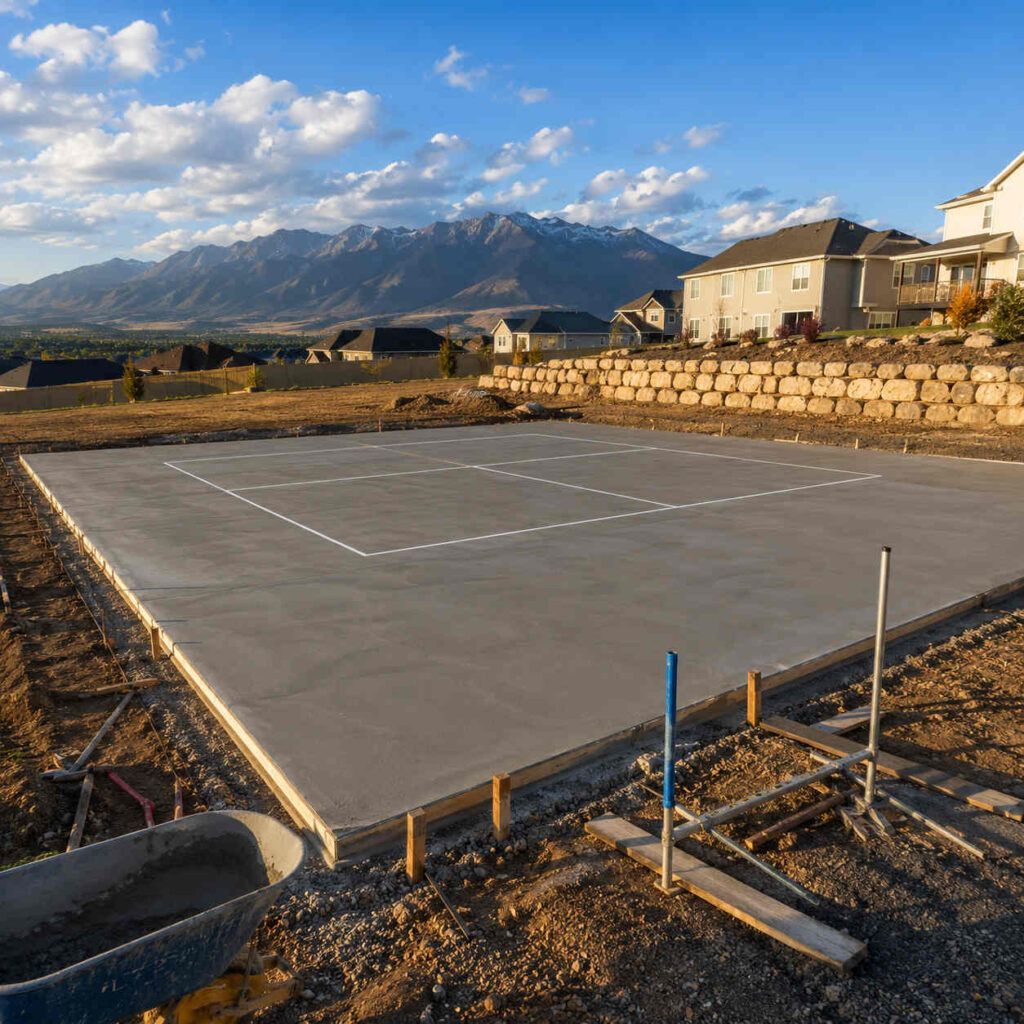
What to Expect From a Pickleball Court Installation in Eagle Mountain, UT
A residential pickleball court typically runs $20,000 to $45,000+ for the concrete base and acrylic surfacing combined on a standard 30 x 60-foot pad, depending on court size, site prep needs, and whether fencing or lighting is added. The concrete phase itself takes just 1-2 days to pour, but Cedar Valley’s clay-heavy, freshly-graded soil makes proper base prep the step that determines whether your court lasts 20 years or starts cracking in three. Here’s exactly what goes into building one right in Eagle Mountain.
Why Eagle Mountain Is Ready for a Pickleball Boom
Pickleball’s popularity has exploded across Utah, and Eagle Mountain’s growth curve puts it in a good position to catch that wave. The city has grown to nearly 77,000 residents, adding thousands of new homes a year across communities like Parkway Fields, Eagle Point, Harmony, Silver Lakes, Red Hawk Ranch, Oquirrh Mountain Ranch, and Firefly. Unlike the denser inner-valley suburbs, most of these newer Eagle Mountain neighborhoods sit on larger lots — which matters, because it means a lot of homeowners here actually have room for a court that wouldn’t fit in Sandy or Midvale.
HOA boards are noticing the same thing. As master-planned communities compete to attract buyers, a shared pickleball court has become one of the amenities residents specifically ask for — right alongside pools and splash pads. If you’re a facility manager fielding that request, or a homeowner who wants one in the backyard, the concrete work is where the project either succeeds or fails.
Why Eagle Mountain’s Soil Changes the Job
This is the part that generic pickleball court guides don’t tell you, and it’s specific to building here. Cedar Valley’s native soil is clay-heavy and alkaline, and a lot of Eagle Mountain’s newest lots — the ones in the fastest-growing developments — still have thin or nonexistent topsoil sitting over grade fill that hasn’t fully compacted. Add Utah’s freeze-thaw winters, and you get soil that expands and contracts with moisture, which is exactly the condition that causes concrete slabs to crack, heave, or settle unevenly if the base isn’t prepared correctly.
For a driveway or patio, an under-compacted base might just mean an annoying crack in a few years. For a pickleball court, it’s worse — an uneven base translates directly into an uneven playing surface, and once the acrylic coating and line striping go on top, fixing a settled section means tearing into a finished court. That’s why proper excavation, compaction, and drainage planning matter more here than in almost any other part of the concrete scope.
What the Concrete Process Actually Involves
A pickleball court isn’t just a slab poured to size — it’s an engineered surface built in a specific sequence:
- Site evaluation and grading — assessing soil conditions, slope, and drainage before anything is dug
- Excavation and base compaction — removing loose fill and compacting a proper aggregate base so the slab has something stable to sit on
- Forming — setting the court to exact regulation dimensions
- Reinforcement and pour — steel or mesh reinforcement, then the concrete pour and finish
- Curing — the concrete needs time to cure before anything else happens
- Surfacing and striping — a sport surfacing contractor applies the acrylic coating and paints the lines once the concrete has cured enough
Xpert Concrete & Seal handles steps 1 through 5 — the full concrete scope — and can coordinate with a sport surfacing contractor for the acrylic coat and striping, or work alongside a surfacing company you’ve already chosen.
How Much Space You Actually Need
One reason pickleball has caught on so fast in newer Eagle Mountain neighborhoods is how little space it actually requires compared to other backyard sport options.
| Court Type | Dimensions | Typical Total Pad (with run-off) |
| Single pickleball court | 20 ft × 44 ft | ~30 ft × 60 ft |
| Two pickleball courts | 40 ft × 44 ft | ~60 ft × 60 ft |
| Standard tennis court | 60 ft × 120 ft | N/A |
A single pickleball court is only about a quarter of the footprint of a tennis court. On the larger lots common in Parkway Fields, Eagle Point, and similar Eagle Mountain developments, that often means room for a private court where a tennis court would never fit — or even two to four courts side by side for an HOA amenity space.
What Drives the Cost
Pricing on a pickleball court installation depends on a handful of factors specific to your project:
| Factor | Why It Affects Cost |
| Court size | Single vs. multi-court layouts scale cost directly |
| Site condition | Sloped lots, poor drainage, or rocky/clay soil require extra grading and compaction |
| Access | Difficult equipment access can add labor time |
| Fencing and lighting | Optional additions increase total project cost |
| Surfacing choice | Acrylic coating and striping is a separate line item from the concrete base |
Because every lot in Eagle Mountain grades and drains a little differently — especially on the newer, still-settling subdivisions — an accurate number requires an on-site walk, not a phone quote.
Timeline: From First Cut to First Serve
| Phase | Typical Duration |
| Site prep and grading | 1 day (varies by site condition) |
| Concrete pour (single court) | 1-2 days |
| Concrete curing | 7-28 days before surfacing can begin |
| Acrylic surfacing and striping | Scheduled after cure, by a sport surfacing contractor |
The concrete work itself moves fast. The part that takes patience is the cure — rushing surfacing onto concrete that hasn’t fully cured is a common shortcut that leads to coating failure down the road.
What’s Included vs. What’s Not
Homeowners comparing bids often assume every quote covers the same scope. It usually doesn’t, and the gaps are where surprises show up later.
| Included in Concrete Scope | Handled Separately |
| Site grading and drainage planning | Acrylic surfacing and color coating |
| Excavation and base compaction | Line striping |
| Forming to regulation dimensions | Fencing |
| Steel/mesh reinforcement | Lighting |
| Concrete pour and finish | Net post installation (coordinated during forming) |
Net post sleeves and center-strap anchors are worth flagging specifically: they need to be set into the concrete during the pour, not drilled in afterward. Deciding on your net system before the pour, not after, avoids a much more expensive retrofit.
Backyard Court or HOA Amenity? Either Way, Concrete Comes First
Whether you’re a homeowner adding a single court in Eagle Point or Harmony, or an HOA board planning a shared multi-court amenity for a growing community, the sequence is the same: the concrete base has to be engineered for Cedar Valley’s soil before any surfacing contractor can do their part. Get that step right, and everything after it — striping, nets, play — goes smoothly for decades.
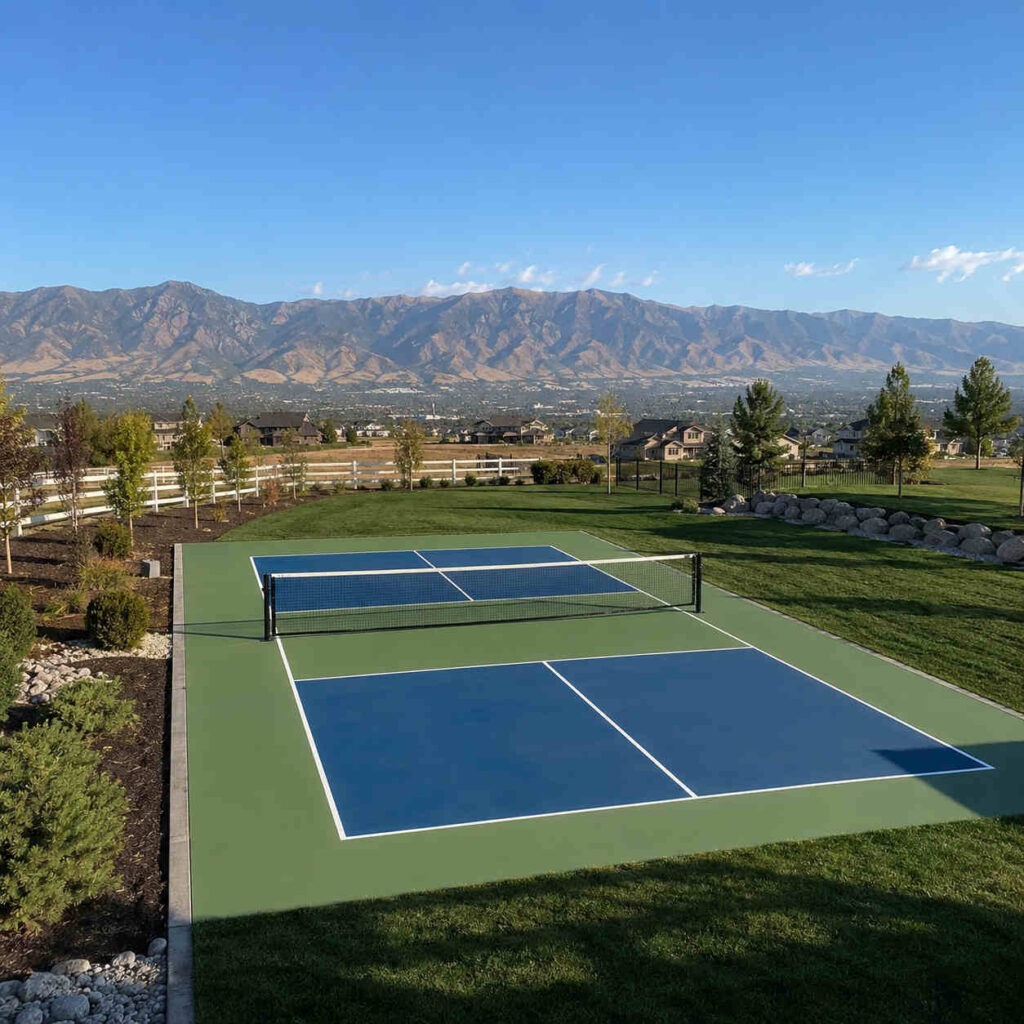
Ready to Build Your Court?
Eagle Mountain’s larger lots make a pickleball court more realistic here than almost anywhere else in the valley — but the same rapid growth that created those lots also means the soil underneath needs to be handled correctly.
Call Xpert Concrete & Seal today at (385) 560-9123 for a free on-site estimate on your pickleball court in Eagle Mountain, and get a base built to last, not just to pass inspection.
Frequently Asked Questions
How much does a pickleball court cost in Eagle Mountain, UT?
A residential single-court installation typically runs $20,000 to $45,000+ total, covering concrete base work and acrylic surfacing. Site conditions, court count, and optional fencing or lighting shift that range — an on-site estimate gives an accurate number for your lot.
What are the dimensions of a standard pickleball court?
A regulation court is 20 feet by 44 feet. With recommended out-of-bounds run-off space included, the total concrete pad is typically closer to 30 by 60 feet.
How many pickleball courts fit where a tennis court would go?
Two to four pickleball courts can typically fit in the footprint of one standard tennis court, depending on exact dimensions and desired run-off space — a popular option for HOAs converting existing sport court space.
Why does soil matter so much for a pickleball court specifically?
Eagle Mountain’s clay-heavy soil and freshly graded new-construction lots are prone to shifting with moisture and freeze-thaw cycles. An under-compacted base creates an uneven playing surface once the court is finished — a problem that’s far more disruptive on a sport court than on a driveway or patio.
Can I add pickleball lines to an existing concrete slab or tennis court?
Yes. If the existing concrete is in good condition, a sport surfacing contractor can often paint new pickleball lines directly onto it without new concrete work.
How long does the whole project take?
The concrete phase for a single court typically takes 1-2 days to pour, followed by 7 to 28 days of curing before the acrylic surfacing and striping go on.
Do I need a permit to build a pickleball court in Eagle Mountain?
Permit requirements vary by project scope and HOA covenants. Check with the city and your HOA before starting, and a local concrete contractor can help you understand what’s typically required for a project like yours.