
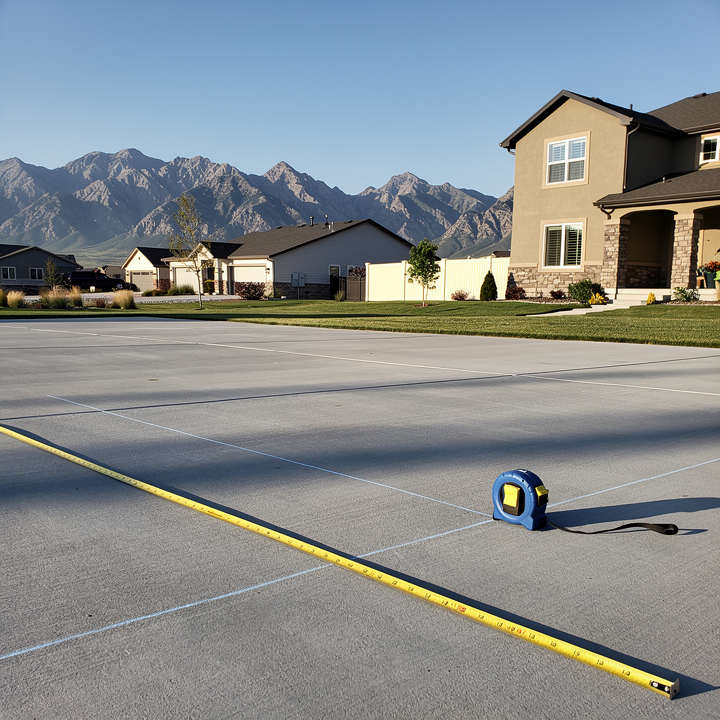
Can You Turn Your Existing Concrete Slab Into a Pickleball Court in Eagle Mountain, UT?
Yes — in many cases, a driveway apron, RV pad, or patio slab you already have in Eagle Mountain can become a pickleball court without pouring new concrete, and it typically costs a fraction of a full build. But “existing concrete” doesn’t automatically mean “ready.” The slab has to be the right size, thick enough, structurally sound, and free of the cracking and settling that’s common on Cedar Valley’s clay-heavy soil. Here’s exactly how to tell whether your concrete qualifies, and what to do if it doesn’t quite make the cut yet.
Why So Many Eagle Mountain Homeowners Are Asking This Question
Eagle Mountain’s newer neighborhoods — Parkway Fields, Eagle Point, Harmony, Silver Lakes, Red Hawk Ranch, Oquirrh Mountain Ranch, and Firefly — sit on some of the larger residential lots in Utah County. That means a lot of these homes already have oversized driveway aprons, RV pads, or patio slabs poured as part of the original build. When homeowners start pricing a full pickleball court and see numbers in the $20,000 to $45,000+ range for a new concrete base and surfacing, the obvious next question is whether the concrete sitting in the side yard already gets them most of the way there.
Sometimes it does. Sometimes it’s close but needs work first. The only way to know is to evaluate the actual slab against what a regulation pickleball surface needs — not just assume a flat gray rectangle is good enough.
What Actually Makes a Slab “Pickleball Ready”
A sport surfacing contractor can coat almost any concrete, but a court that plays well and holds up needs the underlying slab to meet a few specific standards first:
| Requirement | Why It Matters | What Disqualifies It |
| Size | Regulation play area is 20 x 44 ft; a comfortable pad with run-off is closer to 30 x 60 ft | Most single driveways or patios fall short on their own — RV pads and extended parking aprons come closest |
| Thickness | A minimum of 4 inches is standard for a stable playing surface | Older aprons poured thin for foot traffic only, not built to carry a full slab load |
| Level & drainage | The court needs to be flat and drain away from the play area, not toward the house | Slabs that pond water or slope the wrong direction |
| Condition | No active cracking, heaving, or settling | Movement from Cedar Valley’s clay soil, especially common on newer, still-settling lots |
| Control joints | Existing joint layout has to be planned around so it doesn’t telegraph through the coating | Randomly spaced joints, or too few of them for the court dimensions |
Where Cedar Valley’s Soil Comes Back Into the Picture
This is the part that’s specific to building here, not a generic concrete tip. A lot of Eagle Mountain’s driveways, RV pads, and patios were poured early in a subdivision’s build-out, sometimes before the clay-heavy, alkaline soil beneath had fully settled. A slab that looked perfectly fine at year two can develop hairline cracks or a slight heave by year five as the soil keeps shifting with moisture and Utah’s freeze-thaw winters.
That matters more here than it would somewhere else, because a sport surfacing contractor won’t coat a slab that’s actively cracking or unstable — the cracks telegraph straight through the acrylic coating within a season or two, and now you’re paying to fix a court instead of a driveway. This is exactly where the concrete side of the project — not the surfacing side — determines whether the whole thing is worth doing. Xpert Concrete & Seal evaluates the slab first: is a crack cosmetic and stable, or is it a sign of ongoing movement that needs a proper patch, or in worse cases, cutting out and replacing a section before a coating ever goes on.
Existing Slab vs. New Pour: What It Actually Costs
Converting what you already have is almost always cheaper than a new build, but the range is wide because it depends entirely on your slab’s condition:
| Path | Typical Cost Range |
| Lines and color only, over a sound existing slab | $1,500 – $3,500 |
| Full acrylic resurfacing system over existing slab | $5,000 – $12,000 |
| Concrete repair or crack patching before surfacing | Priced on-site, based on damage |
| Removal and replacement of a failed section | Priced like new flatwork, per square foot |
| Full new pickleball court build (site prep through concrete) | $20,000 – $45,000+ |
The honest answer to “what will this cost me” is that it depends entirely on what your slab needs first — that’s a walk-the-lot conversation, not a phone quote.
What the Process Looks Like Starting From Concrete You Already Have
- On-site evaluation — checking size, thickness, slope, drainage, and crack pattern against pickleball requirements
- Repair or replace any compromised sections before surfacing begins
- Confirm the existing control joint layout with your surfacing contractor so it’s planned around, not fought against
- Surfacing contractor applies the acrylic system and paints regulation lines
- Net posts and optional fencing added once the surface is complete
Xpert Concrete & Seal handles the concrete-side evaluation and any repair or replacement work, and can coordinate directly with a sport surfacing contractor for the coating and striping — or work alongside a surfacing company you’ve already chosen.
When You Probably Need a Full New Pour Instead
- Your total usable slab is under roughly 900–1,000 sq ft — smaller than a single court needs
- The slab shows active structural cracking or noticeable heaving, not just cosmetic hairline cracks
- The existing pad is asphalt rather than concrete — this conversion path is concrete-specific
- You’re an HOA planning a purpose-built, multi-court amenity space rather than reusing one homeowner’s driveway
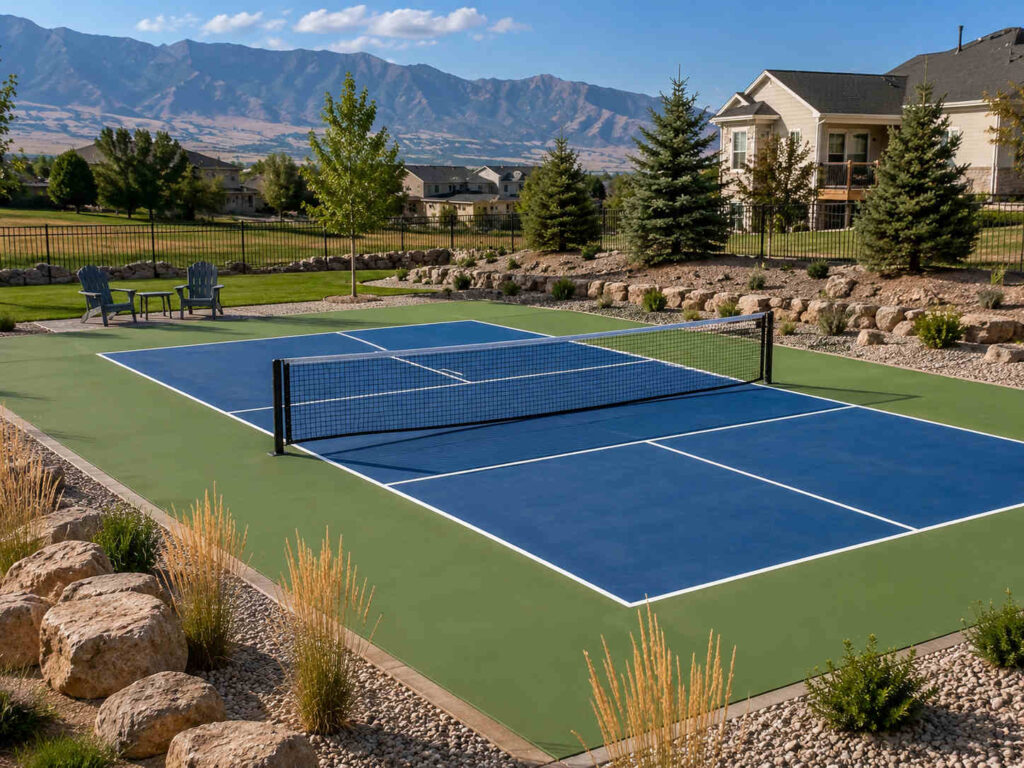
Backyard Upgrade or Just Checking Your Options? Either Way, Start With the Concrete
Whether you’re eyeing that oversized RV pad in Silver Lakes or wondering if your Harmony patio has enough square footage, the answer starts with the same question: is the concrete itself ready to carry a pickleball court? Get that evaluated first, and you’ll know — with real numbers, not guesswork — whether you’re weeks away from playing or looking at a different kind of project.
Call Xpert Concrete & Seal today at (385) 560-9123 for a free on-site evaluation of your existing slab in Eagle Mountain, and find out exactly what it would take to turn what you already have into a court.
Frequently Asked Questions
Can I really turn my driveway or RV pad into a pickleball court?
Often, yes — if the slab is concrete, close to the needed footprint, and free of active cracking or settling. An on-site evaluation confirms whether your specific slab qualifies.
How do I know if my existing slab is thick enough?
Most pickleball surfaces need at least 4 inches of concrete. Thickness isn’t always visible from the surface, so it’s checked as part of the on-site evaluation, often alongside the original pour records if the home is newer construction.
What does it cost to add pickleball lines to existing concrete in Eagle Mountain?
Lines and color over a slab that’s already sound typically run $1,500 to $3,500. A full acrylic resurfacing system runs $5,000 to $12,000. Any concrete repair needed first is priced separately, based on the damage.
Does cracked concrete disqualify my slab?
Not automatically. Cosmetic hairline cracks can often be patched. Active structural cracking or heaving from soil movement usually needs repair, or in some cases replacement of that section, before a surfacing contractor will coat it.
Do I need a concrete contractor or a surfacing company first?
Start with the concrete evaluation. A surfacing contractor can tell you how a coating will look, but a concrete contractor is who determines whether the slab underneath is structurally ready to support one.
Can Xpert Concrete & Seal do the whole project?
Xpert handles the concrete evaluation, repair, and any replacement work, and coordinates with a sport surfacing contractor for the acrylic coating and line striping, or works alongside a surfacing company you’ve already chosen.
How long does converting existing concrete take compared to a new pour?
If the slab needs no repair, the timeline is mostly the surfacing contractor’s schedule for coating and curing. If repair or a section replacement is needed first, add the concrete cure time (typically 7 to 28 days) before surfacing can begin.