
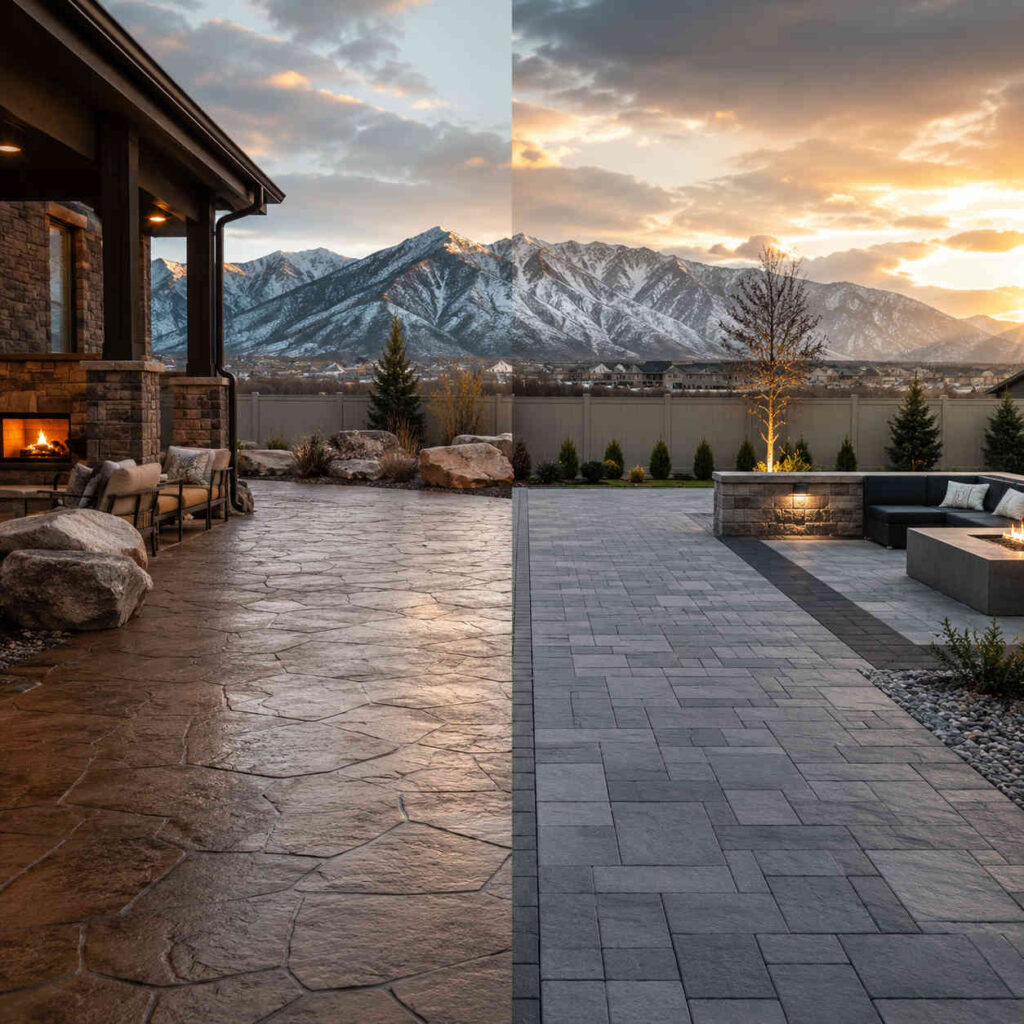
At some point in almost every Eagle Mountain backyard project, the comparison comes up. The homeowner has a quote for stamped concrete and a quote for pavers, the prices are closer than expected, and now they need to actually decide which one makes more sense. It’s a legitimate question and it deserves a straight answer — not one that dodges the trade-offs. This breakdown covers what each material costs in Eagle Mountain and the broader Utah County market, how each handles Cedar Valley’s specific winter conditions, what maintenance looks like over 10 to 20 years, and which situations favor one material over the other.
Cost: What You Actually Pay in Eagle Mountain
Stamped concrete: $12 to $20 per square foot installed for standard single-pattern work in Eagle Mountain, up to $25 for multi-pattern or premium color designs. A 400 square foot patio runs approximately $5,000 to $8,000. Larger projects benefit from better per-foot pricing.
Concrete pavers: $12 to $22 per square foot installed depending on paver type, pattern, and site complexity. Tumbled travertine and premium brick-style pavers push prices higher. A 400 square foot patio in standard interlocking concrete paver runs $5,000 to $9,000.
On a pure material and labor basis, stamped concrete and standard concrete pavers are close in cost for most Eagle Mountain projects. The price gap opens at the high end of each category — elaborate multi-pattern stamped work versus premium natural stone pavers can vary by $5 to $10 per square foot. For most homeowners comparing mid-range options, the deciding factor isn’t price. It’s what you get for that price in Eagle Mountain’s conditions.
Durability in Cedar Valley: How Each Material Handles Utah Winters
This is where location matters most. Eagle Mountain’s elevation of roughly 4,900 feet places it in a harder freeze-thaw environment than the Salt Lake Valley. Cedar Valley gets colder, the wind exposure is higher, and the ground freezes more consistently through the winter months. Both stamped concrete and pavers need to be evaluated against those conditions specifically — not just the general claims you’ll find in contractor marketing materials.
Stamped concrete in Eagle Mountain winters: A properly specified stamped concrete slab — 4,000 PSI minimum, 5 to 7 percent air entrainment, quality UV-resistant sealer — handles Eagle Mountain winters well and can last 25 years or more. The weak point is the sealer. If it degrades and isn’t renewed, freeze-thaw damage begins accumulating in the surface layer. The concrete itself stays structurally intact for decades; what fails first is always the surface presentation if maintenance is skipped.
Pavers in Eagle Mountain winters: Interlocking concrete pavers are individually freeze-thaw resistant, but the system as a whole has a different vulnerability: the base and the joints. Eagle Mountain’s clay-influenced soils and freeze-thaw ground movement shift paver installations over time. Joint sand migrates, individual units rise or settle, and the flat, level surface that was installed becomes uneven within 5 to 10 years without periodic releveling. Polymeric joint sand reduces migration but doesn’t eliminate it entirely. In Cedar Valley’s harder winters, paver installations typically require active maintenance every 3 to 5 years to stay level and tight.
The honest summary: stamped concrete is a monolithic slab that either holds up as a unit or fails as a unit. Pavers are a system of individual pieces that hold up individually but drift as a system. In Eagle Mountain’s conditions, most homeowners find the paver maintenance reality more intrusive than they expected going in.
Maintenance: What Each Material Demands Over Time
Stamped concrete maintenance: Reseal every 2 to 3 years — sooner on high-UV south-facing surfaces in Cedar Valley. Clean with pH-neutral cleaner or pressure wash annually. Fill any cracks that develop with color-matched polyurethane caulk. If properly maintained, the surface requires no other intervention for 20 to 25 years.
Paver maintenance: Refill joint sand every 1 to 3 years as it migrates from wind, rain, and ground movement. Relevel individual units that have shifted — a common occurrence in Eagle Mountain’s soil conditions. Remove and reset sections where settlement has created tripping hazards or water ponding. Apply a paver sealer periodically to reduce staining and joint sand migration. Weeds establish in the joints even with polymeric sand over time and need active management. The individual maintenance tasks are smaller than a full concrete reseal, but they occur more frequently.
Repairability: The One Area Where Pavers Win
This is the genuine advantage pavers hold over stamped concrete, and it’s worth acknowledging directly. If a single paver cracks, chips, or stains beyond cleaning, you pull it out and replace it. The repair is invisible. If a section of stamped concrete develops a structural crack or significant surface damage, the repair is visible. Color matching on aged concrete is difficult — the repair area will be lighter or slightly different in tone from the surrounding surface, particularly in the first year. The difference fades over time but never disappears completely.
For most Eagle Mountain homeowners, this trade-off is acceptable because stamped concrete is less likely to need structural repair than a paver field is to need releveling. But for high-traffic areas where impact damage from vehicles or equipment is possible — a driveway approach, a parking pad — the repairability of pavers is a real consideration.
When Each Material Is the Right Choice for Eagle Mountain
Choose stamped concrete when: You want the look of stone without ongoing leveling and joint maintenance. You’re building a patio, backyard entertaining area, or walkway where vehicle loads aren’t a primary concern. You’re willing to commit to a 2 to 3 year reseal schedule. You value the monolithic stability of a single slab over the flexibility of individual units.
Choose pavers when: You need the ability to access utilities beneath the surface (pavers lift; slabs don’t). You have a project where phased installation makes sense — pavers can be extended more easily than a poured slab. The area receives vehicle traffic and individual unit repairability matters. Your HOA or neighborhood aesthetic specifically calls for a paver look.
Either material works for: Patios, walkways, and pool decks in Eagle Mountain, provided the base is properly prepared and the installation is done by a contractor with real experience in Utah County’s soil and climate conditions.
The Question That Actually Decides It for Most Eagle Mountain Homeowners
After the cost comparison and the durability discussion, most Eagle Mountain homeowners come back to one practical question: in 5 years, which surface am I more likely to be happy with? Stamped concrete that’s been properly sealed twice and still looks close to the day it was installed, or a paver field that’s shifted in a few spots and needs to be releveled before the Freedom Festival party. For backyards in Cedar Valley’s newer neighborhoods, where the soils are younger and still settling and freeze-thaw is harder than average for Utah County, stamped concrete wins that comparison more often than not.
Frequently Asked Questions
Which costs more in Eagle Mountain — stamped concrete or pavers?
For mid-range options, they’re comparable: $12 to $22 per square foot for each. Stamped concrete is slightly less expensive for basic designs; premium pavers cost more than standard stamped work. The real cost difference shows up in long-term maintenance, not the initial install.
Do pavers shift more than stamped concrete in Eagle Mountain?
Yes. Eagle Mountain’s soil conditions and harder freeze-thaw cycles accelerate paver migration compared to more sheltered valley locations. Proper base preparation reduces shifting but doesn’t eliminate it over a 10 to 20 year timeframe.
Can stamped concrete be repaired if it cracks?
Minor cracks can be filled with color-matched caulk. The repair is visible on close inspection but blends reasonably well over time. Structural cracks require more involved repair. Addressing cracks early before they widen produces the best cosmetic outcomes.
How often do pavers need to be releveled in Eagle Mountain?
In Eagle Mountain’s conditions, most paver installations need spot releveling within 5 to 10 years. The frequency depends on base preparation quality, soil conditions on the specific lot, and how hard the freeze-thaw cycles hit that particular area of Cedar Valley.
Which material adds more resale value in Eagle Mountain?
Both add value compared to bare dirt or builder-grade concrete. Stamped concrete in a well-maintained condition with good pattern and color selection tends to show better in photos and home tours — a relevant factor in Eagle Mountain’s active real estate market. Pavers in good condition show similarly well.
Does Xpert Concrete & Seal install both stamped concrete and pavers in Eagle Mountain?
Xpert Concrete & Seal specializes in stamped and decorative concrete throughout Eagle Mountain and Utah County. We design and install custom stamped concrete patios, driveways, walkways, and pool decks built specifically for Cedar Valley’s climate conditions.
Ready to decide? Xpert Concrete & Seal will walk through the comparison with you on-site and give you an honest recommendation for your specific Eagle Mountain project. Call (385) 560-9123 to schedule a free estimate — no pressure, just straight answers.